Key takeaways
- Most IKEA kitchen problems are planning mistakes, not product problems: missing fillers, panels and hinges, wrong clearances and unchecked measurements.
- Check every delivered box against the order list on day one; missing parts found later stall the whole job.
- Order countertops only after cabinets are installed and level, and finish plumbing and electrical rough-in before cabinets arrive.
- Budget for demolition, a bulkhead, sales tax and a plumber, the four items most first-time budgets leave out.
On this page
- Mistake 1: Wrong Measurements
- Mistake 2: Not Ordering Enough Filler
- Mistake 3: Ignoring Wall Condition
- Mistake 4: Skipping the Suspension Rail
- Mistake 5: Wrong Cabinet Depth for Appliances
- Mistake 6: Forgetting Toe Kicks
- Mistake 7: Not Planning for Plumbing
- Mistake 8: Ordering During Non-Sale Periods
- Mistake 9: Not Checking Appliance Dimensions
- Mistake 10: Inadequate Ventilation Planning
- Mistake 11: Skipping Cover Panels
- Mistake 12: Wrong Handle Placement
- Mistake 13: Not Considering Lighting
- Mistake 14: Forgetting About Water Shut-Off
- Mistake 15: Not Verifying Floor Level
- The Meta-Mistake: Not Having a Complete Plan
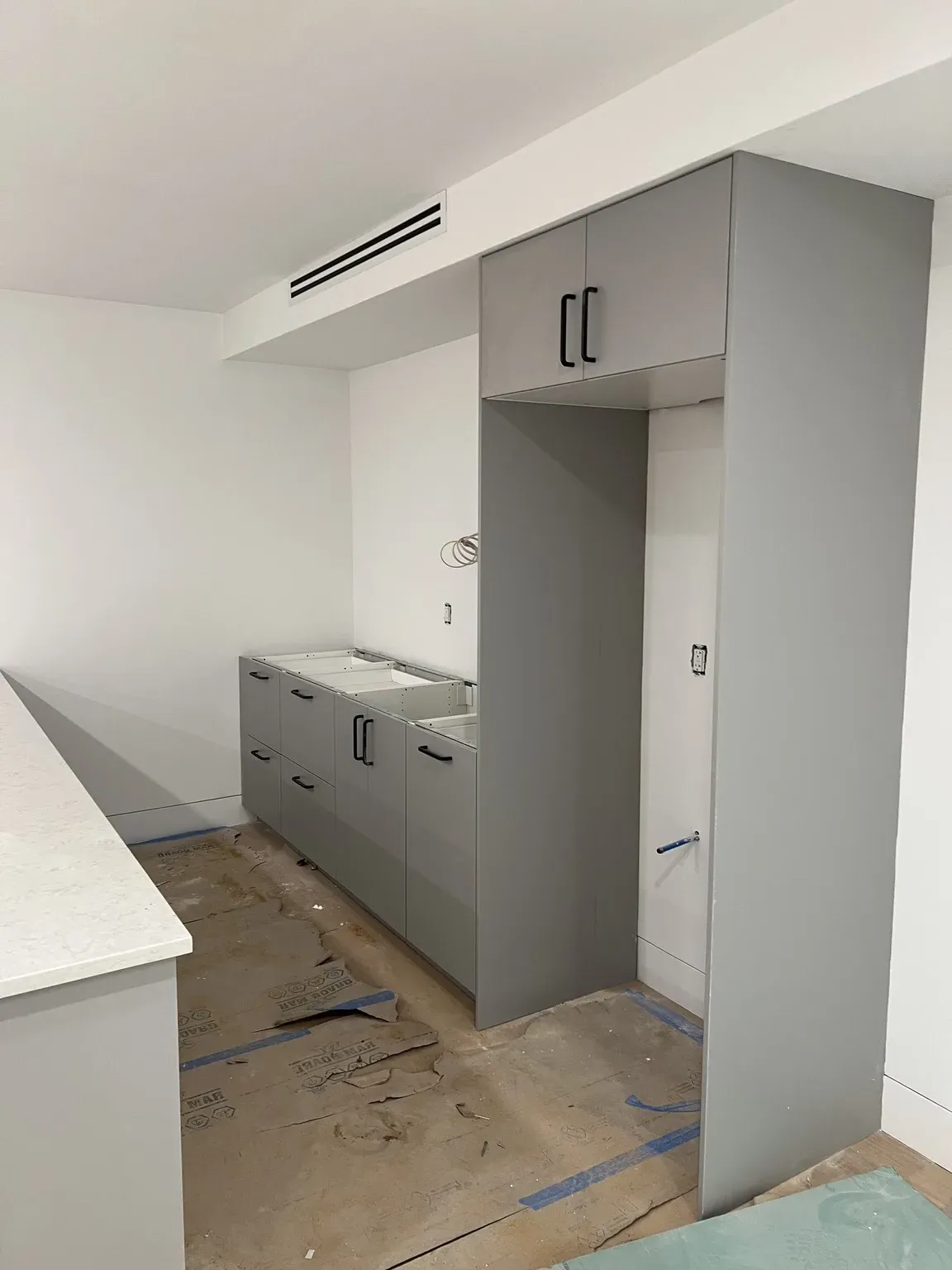
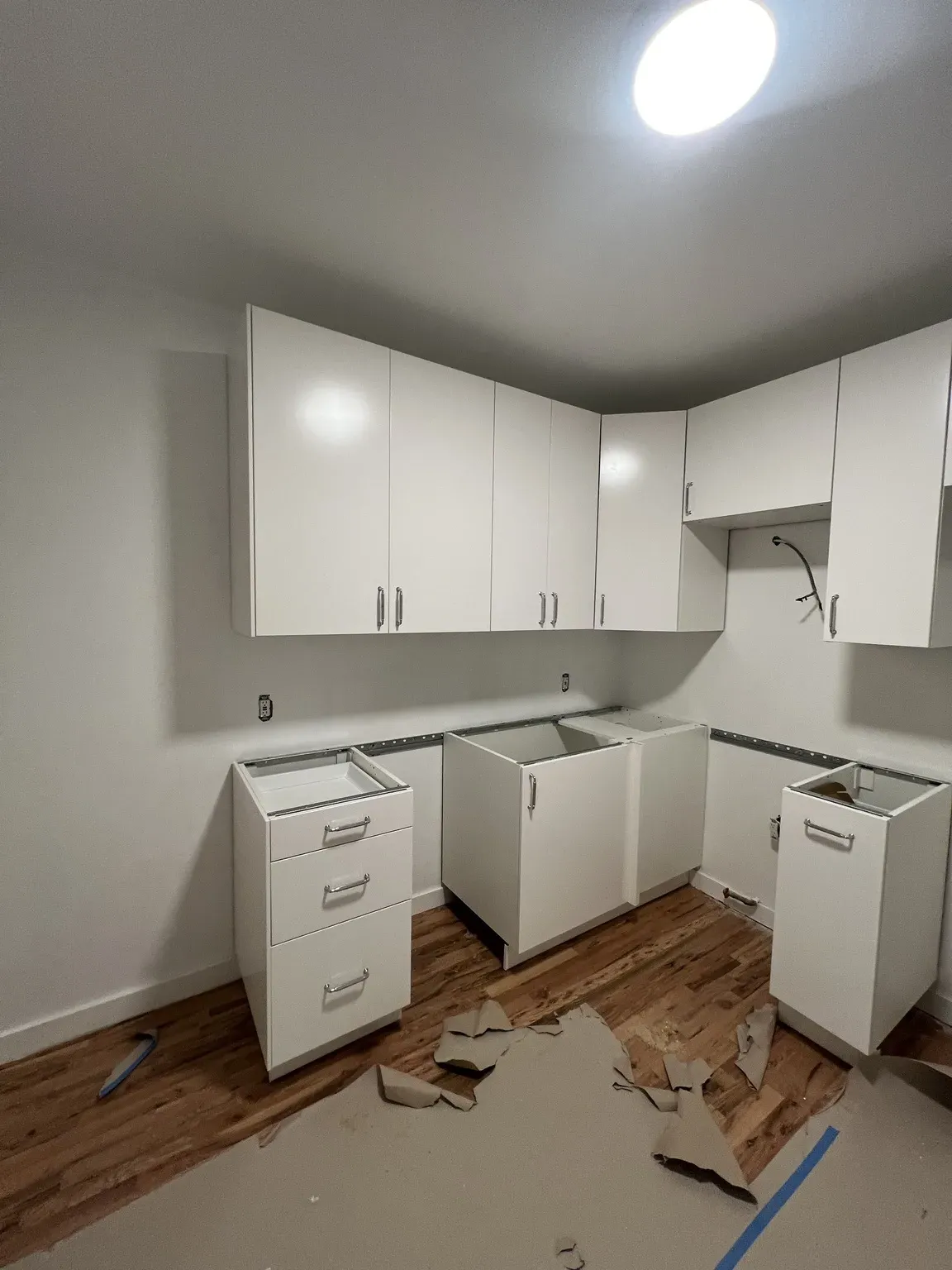
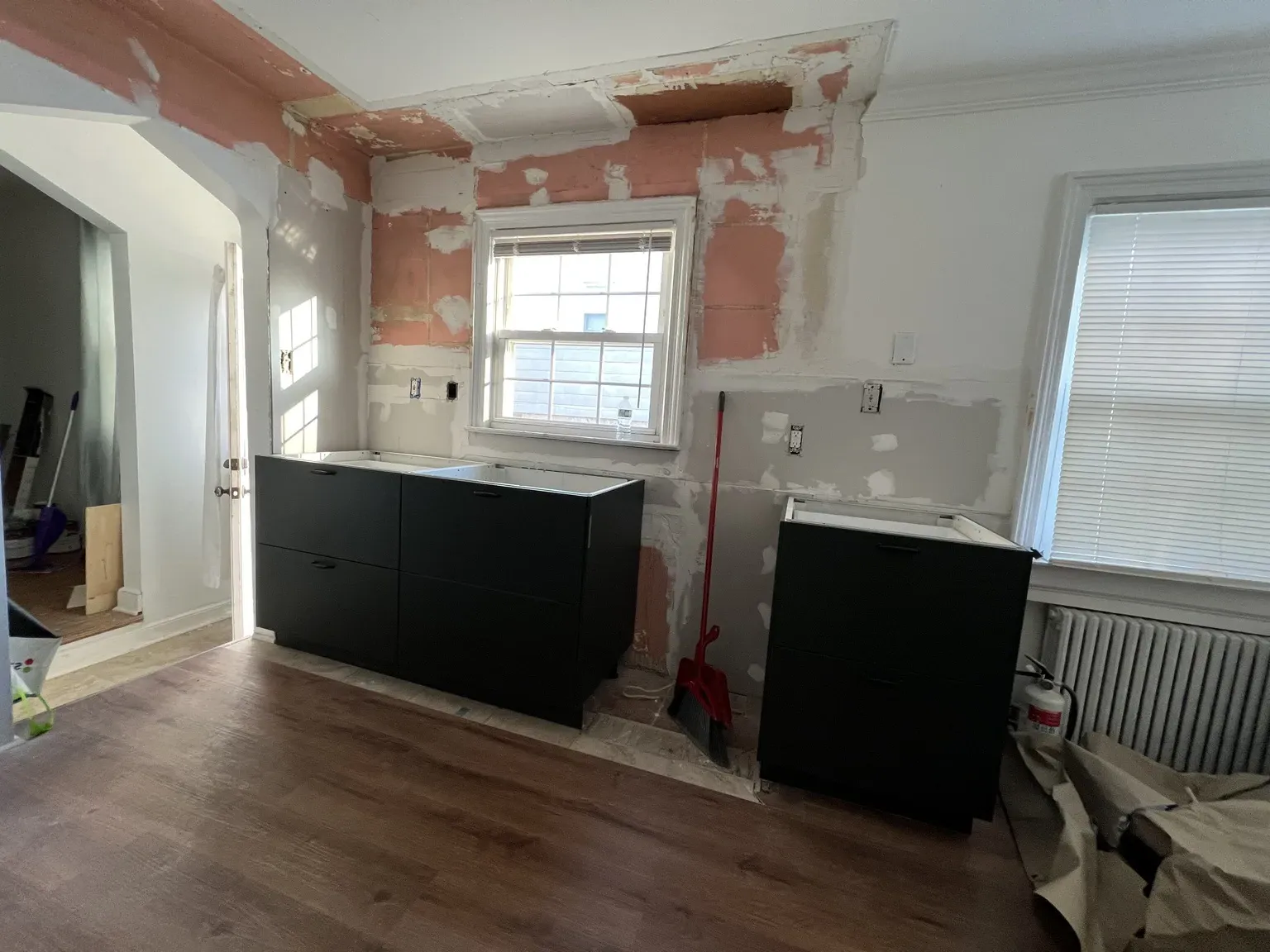
We've installed hundreds of IKEA kitchens across Massachusetts, Connecticut, and Rhode Island. Along the way, we've seen homeowners — smart, capable people — make the same mistakes over and over. Some of these mistakes cost a few hours. Others cost thousands of dollars and weeks of delay.
Here are the 15 most common IKEA kitchen mistakes, why they happen, and how to avoid every single one.
Mistake 1: Wrong Measurements
What happens: The kitchen is measured incorrectly (or not measured at all beyond rough dimensions), and the cabinet plan doesn't fit the actual space. Cabinets are too wide, too tall, or in the wrong position.
Why it's so common: People trust that their kitchen is roughly a certain size and don't verify. Or they measure once, quickly, and get it wrong.
How to avoid it: Measure everything at least twice. Measure walls at three heights. Check for level and plumb. We have a complete measurement guide that walks you through every step.
Cost of this mistake: Potentially significant — wrong measurements can mean reordering cabinets, custom filler pieces, or a complete redesign.
Mistake 2: Not Ordering Enough Filler
What happens: Gaps appear between cabinets and walls, at the ends of runs, and around appliances. The kitchen looks unfinished and amateurish.
Why it's so common: Filler strips seem like a minor detail during the planning stage. People don't realize how much filler they'll need, especially in older homes with irregular walls.
How to avoid it: Order at least 3-4 more filler strips than your plan calls for, in both widths (narrow and wide). You can return unused ones. In older New England homes with out-of-plumb walls, you might need double what you'd expect.
Cost of this mistake: A delayed project plus a second trip to IKEA or a delivery charge for additional filler strips.
Mistake 3: Ignoring Wall Condition
What happens: The suspension rail is installed on a wall that's crumbling, has weak plaster, or has no studs where needed. Wall cabinets sag, pull away from the wall, or — in the worst case — fall.
Why it's so common: The wall looked fine behind the old cabinets. Nobody checked until the new rail was going up.
How to avoid it: After demolishing the old kitchen, inspect the walls thoroughly. Check for:
- Solid stud locations where the rail needs to be mounted
- Crumbling plaster or water-damaged drywall
- Signs of water intrusion or mold Repair any issues before installing the suspension rail. Consider adding plywood backing for reinforcement if the wall is in rough shape.
Cost of this mistake: Wall repair, potential cabinet damage, and significant project delays if cabinets fall or sag.
Mistake 4: Skipping the Suspension Rail
What happens: Someone tries to mount wall cabinets by screwing directly through the cabinet backs into the wall, bypassing IKEA's suspension rail system entirely.
Why it's so common: It seems faster and simpler. The old cabinets might have been mounted that way.
How to avoid it: Always use the IKEA suspension rail. It distributes weight properly, allows for precise adjustment, and is a fundamental part of the SEKTION system. The rail isn't optional — it's how the system is designed to work.
Cost of this mistake: Potentially the entire kitchen if cabinets come off the wall. Plus the wall damage from failed mounting.
Mistake 5: Wrong Cabinet Depth for Appliances
What happens: A refrigerator sticks out 4 inches past the cabinets, or a range doesn't fit in the allotted space, or a dishwasher can't open because it hits the island.
Why it's so common: People design around generic appliance sizes without measuring their specific appliances. Or they plan for standard-depth appliances and then buy counter-depth (or vice versa).
How to avoid it: Get the exact model numbers of every appliance before finalizing your kitchen plan. Download the specification sheets from the manufacturer's website and note the exact dimensions, including door swing clearances. IKEA's planner has generic appliance placeholders, but they may not match your actual appliances.
Cost of this mistake: Potentially a redesign of the cabinet layout or the cost of returning and reordering appliances that fit properly.
Mistake 6: Forgetting Toe Kicks
What happens: The kitchen is installed beautifully — then everyone realizes the gap under the cabinets (between the adjustable legs and the floor) is exposed, showing raw cabinet bottoms and plumbing.
Why it's so common: Toe kicks (FORBATTRA in IKEA's catalog) are a separate order item and easy to forget.
How to avoid it: Add toe kicks to your order from the start. You'll need enough linear footage to cover the front of all base cabinets, plus the sides of end cabinets. Order 10% extra for cuts and waste.
Cost of this mistake: A second trip to IKEA for toe kick panels plus the delay of waiting for them if they're out of stock.
Mistake 7: Not Planning for Plumbing
What happens: Cabinets are installed and then the plumber can't connect the sink because the drain is in the wrong spot, supply lines don't reach, or there's no access hole cut in the cabinet back.
Why it's so common: Cabinet installation and plumbing are different trades, and homeowners don't always coordinate between them.
How to avoid it: Know your plumbing locations before ordering. Mark them during measurement (see our measurement guide). Plan your sink cabinet around existing plumbing when possible. If plumbing needs to move, schedule the plumber for rough-in work BEFORE cabinet installation. Read our plumbing guide for specifics.
Cost of this mistake: Plumber fees to relocate pipes, plus possible cabinet modifications and project delays.
Mistake 8: Ordering During Non-Sale Periods
What happens: You pay full price for your IKEA kitchen when a 15-20% sale might be just weeks away.
Why it's so common: People get excited and order immediately, or they're not aware IKEA has predictable sale patterns.
How to avoid it: IKEA typically runs kitchen sales 2-3 times per year. If your timeline allows, plan your purchase around these sales. Read our guide on when IKEA has kitchen sales for historical patterns and timing tips.
Cost of this mistake: You miss out on 15-20% savings on your entire kitchen cabinet order.
Mistake 9: Not Checking Appliance Dimensions
What happens: The dishwasher doesn't fit under the countertop, the range sticks out past the cabinets, or the microwave is too wide for the upper cabinet opening.
Why it's so common: Similar to Mistake 5, but specifically about double-checking dimensions against the IKEA cabinet openings.
How to avoid it: IKEA base cabinets have a 24-inch internal opening for a dishwasher, which fits most standard dishwashers. But some European or specialty dishwashers are different. Verify everything. And remember that countertop overhang can reduce the effective opening height.
Cost of this mistake: Returning appliances (restocking fees), buying replacements, and potentially reordering cabinets if the layout needs to change.
Mistake 10: Inadequate Ventilation Planning
What happens: There's no range hood, or the range hood can't be properly vented, or the ductwork doesn't fit through the cabinets and wall.
Why it's so common: Ventilation is an afterthought. People pick a range hood last and assume it'll work.
How to avoid it: Plan your ventilation from the beginning. Decide whether you want ducted or ductless. If ducted, plan the duct route (through the wall or through the ceiling). Make sure the wall cabinet above the range can accommodate the hood. Read our ventilation guide.
Cost of this mistake: Retrofitting ductwork after cabinets are installed, which may require removing and reinstalling cabinets.
Mistake 11: Skipping Cover Panels
What happens: Exposed cabinet sides — at the end of a cabinet run, the side of an island, or next to an appliance — show raw particleboard instead of a finished surface.
Why it's so common: Cover panels (also called end panels) are a separate order item, and the IKEA planner sometimes underestimates how many you need.
How to avoid it: Walk through your plan and identify every cabinet side that will be visible. Each one needs a cover panel in your chosen door style. Don't forget the sides of islands, peninsulas, and any cabinet that faces a doorway or open space.
Cost of this mistake: Ordering and waiting for additional cover panels, plus the visual distraction of exposed particleboard in the meantime.
Mistake 12: Wrong Handle Placement
What happens: Handles are drilled into doors at inconsistent heights, in the wrong position (centered when they should be offset, or vice versa), or in a spot that looks awkward.
Why it's so common: People drill handles freehand without a template or consistent measurement system.
How to avoid it: Buy a handle drilling template — they're inexpensive and available at any hardware store. Decide on your handle position before you start — upper cabinets typically have handles at the bottom, and base cabinets at the top, but there are different schools of thought. Use the template for every single door to ensure consistency. Mark, drill, and install one door first as a test.
Cost of this mistake: Potentially the cost of replacement doors if you drill in the wrong spot (holes in foil-wrapped doors can't be patched invisibly).
Mistake 13: Not Considering Lighting
What happens: The kitchen is dark. Under-cabinet task lighting wasn't planned for, so there's no wiring where it needs to be. Or recessed lights are blocked by wall cabinets.
Why it's so common: Lighting gets planned last or not at all.
How to avoid it: Plan lighting early. At minimum, plan for:
- Under-cabinet lighting — IKEA's OMLOPP or IRSTA LED strips, or third-party options. These need either a nearby outlet or wired connection.
- In-cabinet lighting — great for glass-front cabinets
- General overhead lighting — make sure recessed lights clear the tops of wall cabinets
If you need new electrical for lighting, that work must happen before cabinets are installed.
Cost of this mistake: Electrician fees to add wiring after cabinets are installed, which may require removing and reinstalling cabinets to run new wires.
Mistake 14: Forgetting About Water Shut-Off
What happens: During installation, someone needs to turn off the water and discovers the shut-off valve is rusted shut, missing, or located in an inaccessible spot behind the new cabinets.
Why it's so common: Nobody thinks about shut-off valves until they need one.
How to avoid it: Before installation begins, test your kitchen water shut-off valves. If they don't work, replace them. And plan your cabinet layout to ensure shut-off valves remain accessible — in Massachusetts and Connecticut, building code requires accessible shut-offs.
Cost of this mistake: An emergency plumber visit plus potential water damage if a valve fails during installation.
Mistake 15: Not Verifying Floor Level
What happens: Cabinets are installed and then nothing lines up. Doors are at different heights across the run. Countertop has a visible slope. Drawers roll open by themselves.
Why it's so common: People assume floors are level. In New England, they almost never are — even in relatively new homes.
How to avoid it: Check floor level before ordering and again before installation. IKEA's adjustable legs can compensate for quite a bit, but you need to know what you're working with. See our guide on leveling cabinets on uneven floors.
Cost of this mistake: Hours of re-adjustment, or in severe cases, complete reinstallation of the base cabinet run.
The Meta-Mistake: Not Having a Complete Plan
The thread connecting most of these mistakes is inadequate planning. Rushing from "I want a new kitchen" to placing an IKEA order without thoroughly measuring, checking conditions, and thinking through every detail is the single biggest risk factor.
We get it — you're excited about your new kitchen, and planning feels tedious compared to picking out door styles and drawer organizers. But the planning phase is where projects are won or lost.
If you'd like professional help avoiding all 15 of these mistakes, Hearthstone Kitchens offers full planning, measurement, and installation services throughout Massachusetts, Connecticut, and Rhode Island. Contact us and let us make sure your IKEA kitchen goes smoothly from start to finish.
Frequently asked questions
About the authors
This guide was written and reviewed by the Hearthstone Kitchens installation team, who have installed 600+ IKEA kitchens in Massachusetts, Connecticut and Rhode Island over 7+ years. Prices reflect what we see on real quotes in 2026 and are updated when the market moves. We are an independent installer and are not affiliated with IKEA.
Ready to talk about ikea cabinet assembly?
Upload your IKEA plan or a few photos. We will check it for missing pieces and send an itemized estimate within 3 hours, free and with no obligation.