Key takeaways
- Find the highest point of the floor along the cabinet run and level everything to it; the toe kick hides the difference.
- SEKTION legs adjust roughly 3.5 to 5 inches; beyond that, use a plywood platform or taller legs so the countertop height stays near 36 inches.
- Level front to back and side to side on every cabinet, then check the whole run with a long level or laser before screwing cabinets together.
- Wall cabinets do not care about the floor; the suspension rail sets their level independently.
Cost
Included; a platform adds $100–$300
Time
1–3 hours per run
Difficulty
Moderate
Tools
4-ft level, shims, leg adjuster, clamps
On this page
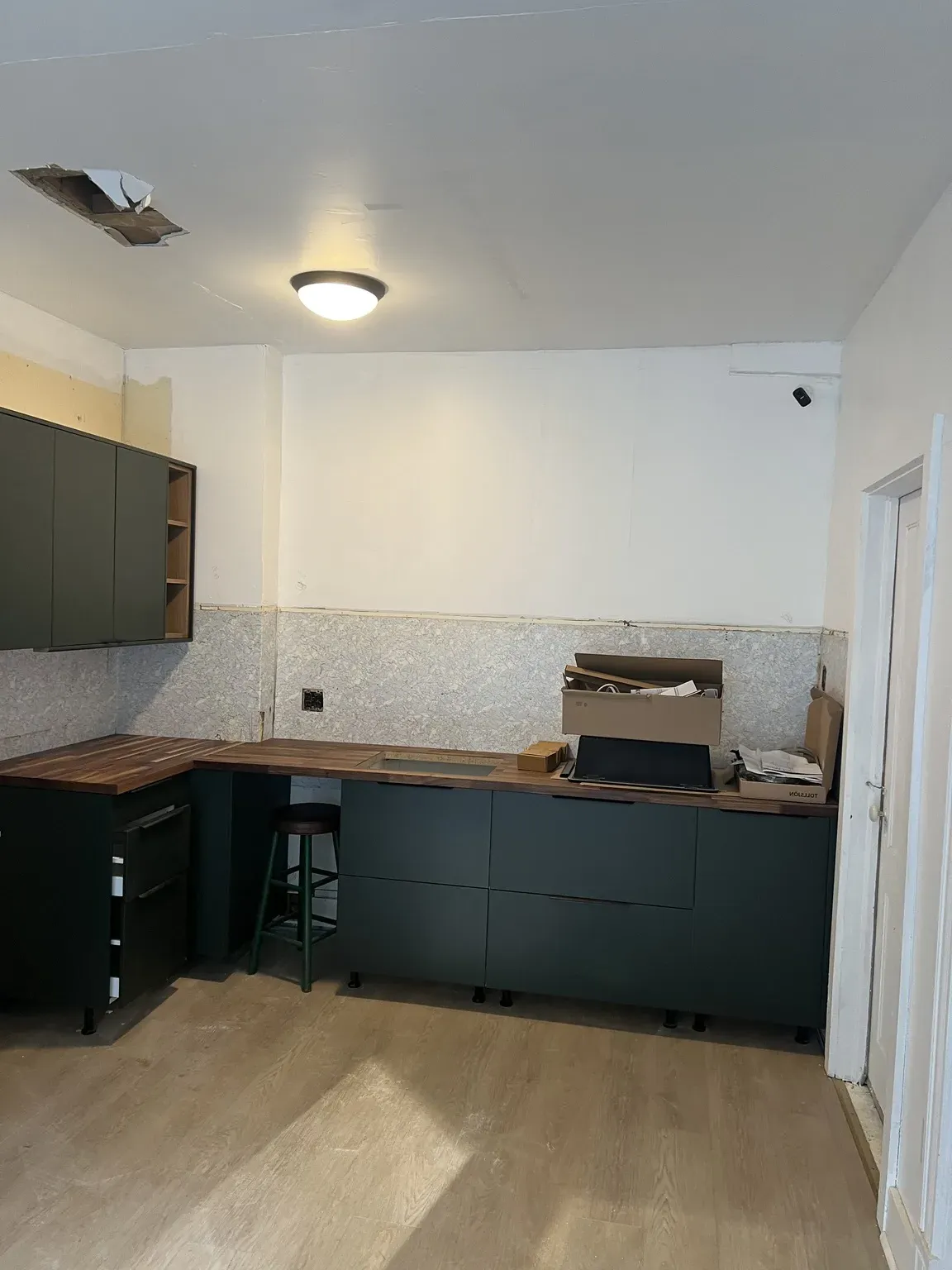
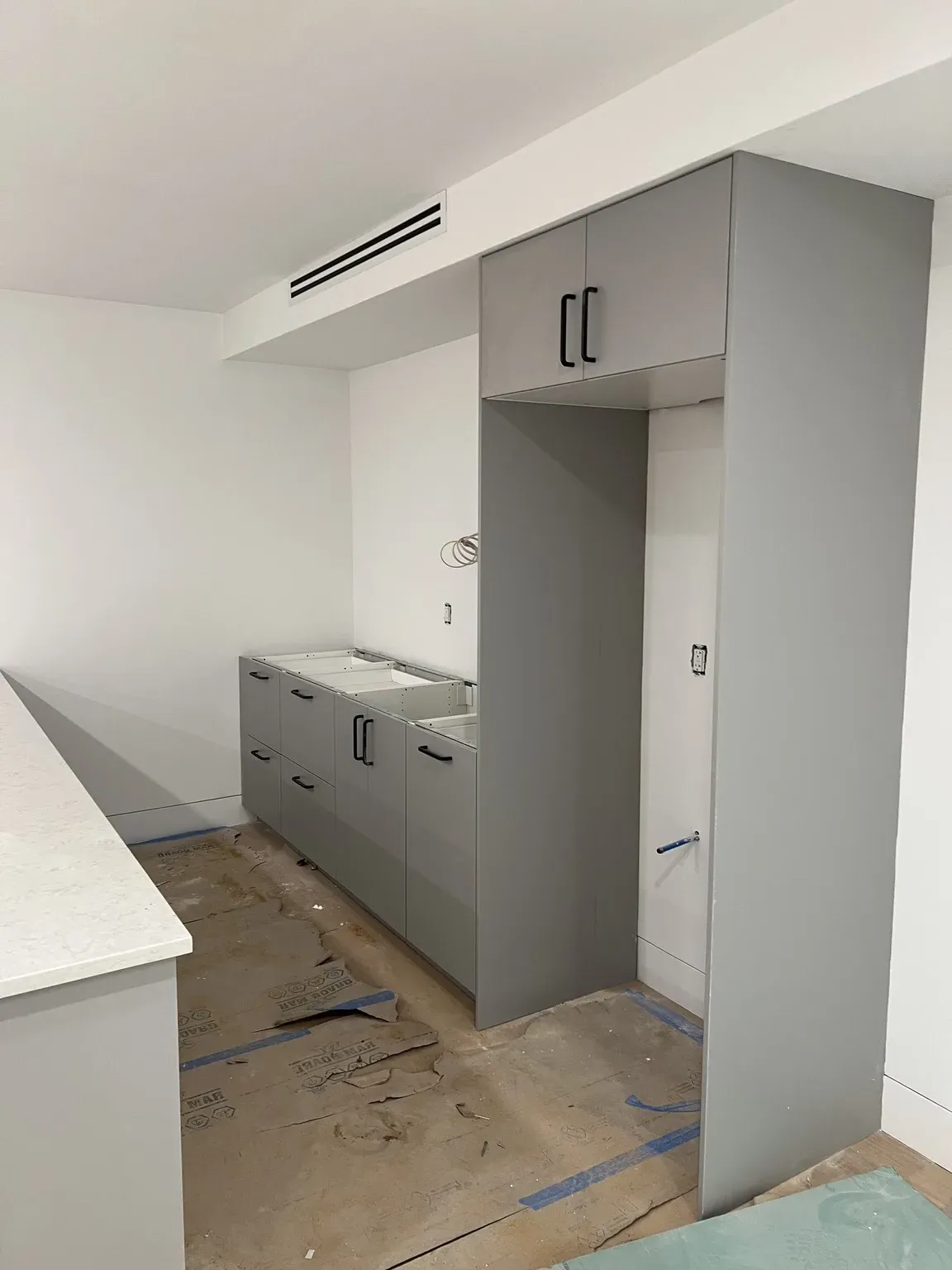
If there's one thing we can guarantee about kitchen installations in New England, it's this: the floors won't be level. In our experience installing IKEA kitchens across Massachusetts, Connecticut, and Rhode Island, perfectly level floors are the exception — maybe 1 in 20 kitchens. The rest have some degree of unevenness, ranging from barely noticeable to dramatically sloped.
The good news is that IKEA's SEKTION cabinet system was designed to handle this. The adjustable leg system gives you real flexibility. Here's exactly how to get your cabinets perfectly level, no matter what your floor is doing.
Why Floor Levelness Matters
You might wonder: does it really matter if the cabinets are a little off? The answer is yes, for several important reasons:
- Countertop fit: A countertop installed on unlevel cabinets will have gaps, won't sit flush, and may crack (especially stone or quartz). Fabricators will refuse to install on unlevel base cabinets.
- Door and drawer alignment: If cabinets aren't level, doors and drawers won't open and close properly. Doors may swing open or closed on their own.
- Visual appearance: Even a slight slope is noticeable to the eye, especially along a long run of cabinets. Your brain expects kitchen lines to be horizontal.
- Appliance function: Dishwashers and ranges need to be level for proper operation. A dishwasher that's not level won't drain properly.
- Structural integrity: Cabinets that are racked (twisted due to sitting on an uneven surface) put stress on joints and can lead to premature failure.
How to Check Floor Level
Before you start installing, check the floor thoroughly:
Basic Method: 4-Foot Level
- Place a 4-foot level on the floor along each wall where cabinets will go
- Note the direction and degree of slope
- Move the level to several positions along each wall
- Also check perpendicular to the walls (front-to-back slope)
- Check diagonally across the kitchen
Better Method: Laser Level
- Set a laser level at the approximate height of the cabinet tops (about 34-35 inches above the floor)
- Measure from the laser line to the floor at multiple points along each wall
- The difference in these measurements tells you exactly how much the floor is off
- Record the highest and lowest points
Professional Method: Water Level or Transit Level
For large kitchens or severe unevenness, a water level or builder's transit gives the most accurate readings across long distances.
What You're Looking For
- Where is the highest point of the floor? This is your reference point.
- How much does the floor drop from the high point? This tells you the range of adjustment needed.
- Are there localized bumps or dips? These may need to be addressed separately.
IKEA's Adjustable Leg System Explained
SEKTION base cabinets come with adjustable plastic legs:
- Standard legs: Adjust from approximately 4 inches to 8.5 inches. Included with each base cabinet.
- Leg height adjustment: Turn the leg clockwise to raise, counterclockwise to lower. Each full turn changes height by about 3mm.
- Number of legs: Each base cabinet gets 4 legs (two in front, two in back). Wide cabinets (36") benefit from an additional support leg in the center if carrying heavy countertops.
- Leg attachment: The legs clip into brackets on the bottom of the cabinet frame.
Leg Adjustment Range
The standard IKEA legs give you about 4.5 inches of adjustment range. For most floors, this is sufficient. If your floor varies by more than about 1.5 inches within the cabinet run, you may need additional strategies (covered below).
Step-by-Step Leveling Process
Step 1: Identify the High Point
Using your level measurements, identify the highest point of the floor along the cabinet run. Your first cabinet will be placed here with the legs at their lowest (or close to lowest) setting.
Step 2: Set Reference Height
The top of your base cabinets should be 34.5 inches above the floor at the high point (this is the standard IKEA base cabinet height, which will give you 36 inches total with a 1.5-inch countertop). Mark this height on the wall at the high point — this is your reference line.
Step 3: Extend the Reference Line
Using a long level or laser level, extend this horizontal reference line along all walls where base cabinets will be installed. This line represents where the tops of all your base cabinets need to be.
Step 4: Install the First Cabinet
Place the first cabinet at or near the floor's high point. Adjust the four legs until the cabinet top aligns with your reference line. Check level front-to-back and side-to-side with your 4-foot level.
Step 5: Install Adjacent Cabinets
Place the next cabinet in line. Adjust its legs until:
- The top is at the same height as the first cabinet (check with a level placed across both cabinets)
- The cabinet is level front-to-back
- The cabinet face is flush with the first cabinet's face
Clamp the cabinets together through the face frames and drill/screw them together.
Step 6: Continue the Run
Repeat for each subsequent cabinet. Always check level in both directions and alignment with adjacent cabinets. As you get further from the high point, the legs will need to be set progressively higher to compensate for the dropping floor.
Step 7: Final Check
Once all base cabinets are installed, place a long level (or straight board with a level on top) across the entire run. Check for any dips or humps. Fine-tune individual legs as needed.
Techniques for Severely Uneven Floors
When floors are more than 1.5 inches off level — which we see regularly in older homes in communities like Marblehead, Wickford, and Mystic — standard leg adjustment may not be enough. Here are advanced solutions:
Extended Legs or Leg Risers
IKEA doesn't officially sell extended legs, but you can:
- Stack standard legs using a wooden block as an extension
- Use aftermarket cabinet legs with greater adjustment range (available at specialty cabinet hardware suppliers)
- Build custom wooden blocks to raise the low-side legs
Leveling the Floor with Self-Leveling Compound
For severe unevenness (2+ inches), pouring self-leveling compound may be the best approach:
- Level this frame using shims and lag bolts to the subfloor
- Set the IKEA cabinets on top of the frame
- Extend the toe kick to cover the frame
This approach adds 1.5-3.5 inches to the cabinet height, so plan accordingly for your final counter height and ceiling clearance.
Shimming Individual Cabinets
For localized bumps or dips:
- Use cedar shims under the cabinet legs at specific points
- Glue shims in place once the correct height is achieved
- Cut shims flush with the cabinet sides so they don't interfere with toe kick installation
Toe Kick Solutions for Varying Heights
When cabinets are leveled on an uneven floor, the gap between the bottom of the cabinets and the floor will vary along the run. This is where toe kicks (FORBATTRA in IKEA's lineup) come in.
Standard Approach
IKEA toe kicks attach with clips to the front legs. On a perfectly level floor, the toe kick is a uniform strip. On an uneven floor:
- The toe kick follows the floor's contour at the bottom edge
- The top edge is hidden behind the cabinet overhang
- As long as the gap doesn't exceed the toe kick height (about 4.5 inches), a single piece covers it
Scribe to Fit
For uneven floors:
- Hold the toe kick against the cabinet legs
- Use a pencil and a scrap piece of wood as a scribing tool to trace the floor contour onto the toe kick
- Cut along the scribed line with a jigsaw
- The toe kick now follows the floor perfectly while the top edge remains hidden
Extra-Deep Toe Kick Gaps
If the gap exceeds the standard toe kick height at the low point:
- Use taller toe kick material (available from cabinet hardware suppliers)
- Add a strip of matching material below the standard toe kick
- Paint or finish the addition to match
Front-to-Back Leveling
Don't forget that cabinets must also be level from front to back. This is less commonly an issue than side-to-side, but it matters:
- If the floor slopes away from the wall, the front legs need to be shorter than the back legs
- If the floor slopes toward the wall, the opposite is true
- Front-to-back levelness is critical for drawer operation — if the cabinet tips forward, drawers will roll open; if it tips backward, they'll roll closed
Pro Tips from Our Installation Team
-
Start from the highest point and work outward. This ensures you're always raising cabinets (adjusting legs higher), never trying to lower them past the minimum height.
-
Use a laser level for long runs. A 4-foot bubble level is fine for individual cabinets, but for checking alignment across a 15-foot run of cabinets, a laser level is invaluable.
-
Check level after connecting cabinets to each other. The act of screwing cabinets together can pull them slightly out of level.
-
Don't forget to re-check after mounting to the wall. Pulling cabinets tight to an uneven wall can affect their level.
-
Level is more important than flush to the wall. If you have to choose between perfectly level cabinets and cabinets that sit perfectly flush against the wall, choose level every time. Gaps at the wall can be covered with filler strips or caulk. Unlevel cabinets cause functional problems.
-
Account for countertop weight. Heavy stone countertops can cause slight settling after installation. Some installers shim slightly high at the center of long runs to compensate — but this is an advanced technique that requires experience.
When to Call Hearthstone Kitchens
Leveling is the part of IKEA kitchen installation that separates professional results from DIY frustration. If you're dealing with significantly uneven floors in your Massachusetts, Connecticut, or Rhode Island home, our team has the experience and tools to get your cabinets perfectly level. Reach out for a free consultation — we'll assess your floor and recommend the best approach for your situation.
Frequently asked questions
About the authors
This guide was written and reviewed by the Hearthstone Kitchens installation team, who have installed 600+ IKEA kitchens in Massachusetts, Connecticut and Rhode Island over 7+ years. Prices reflect what we see on real quotes in 2026 and are updated when the market moves. We are an independent installer and are not affiliated with IKEA.
Ready to talk about ikea cabinet assembly?
Upload your IKEA plan or a few photos. We will check it for missing pieces and send an itemized estimate within 3 hours, free and with no obligation.