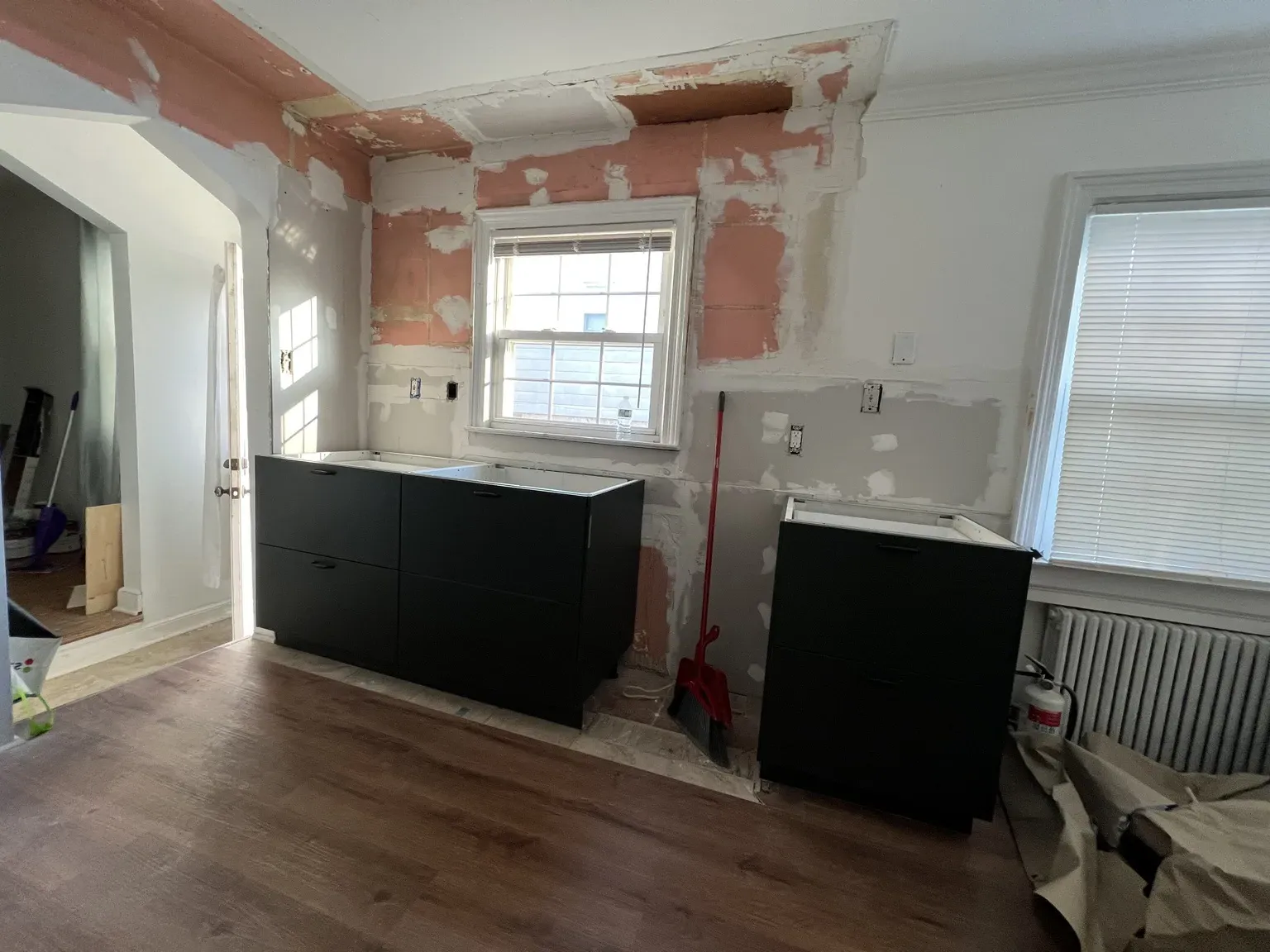
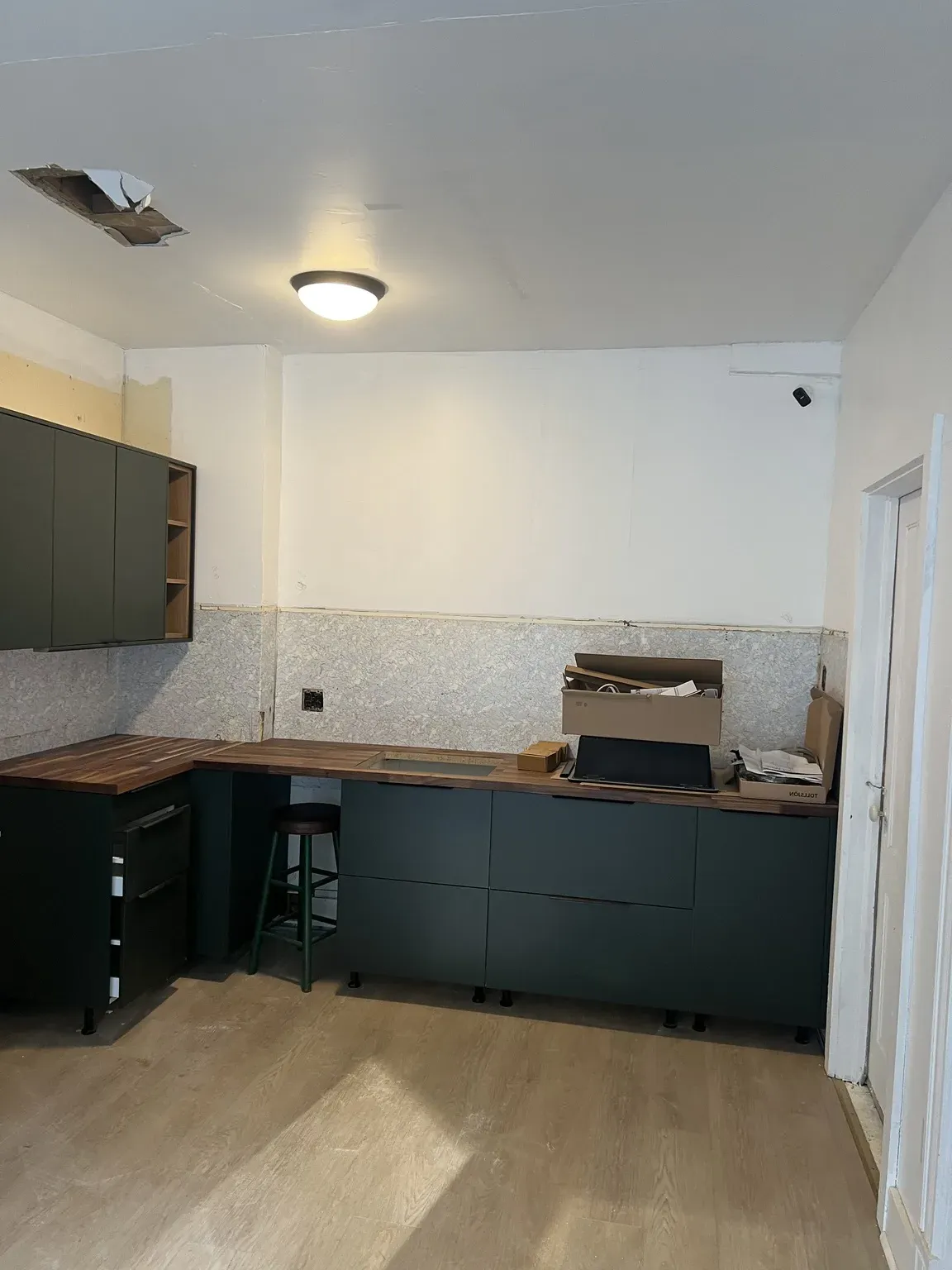
Key takeaways
- Measure every wall at three heights and record the smallest number; New England walls are rarely straight.
- Note the exact position and size of windows, doors, outlets, switches, plumbing, gas lines and vents relative to a fixed corner.
- Measure ceiling height in several spots; a half-inch difference decides whether wall cabinets can reach the ceiling.
- Leave your measurements in inches to one-sixteenth and photograph everything; the IKEA planner and your installer both work from them.
Cost
Free
Time
1–2 hours
Difficulty
Easy
Tools
Tape measure, 4-ft level, notepad, phone camera
On this page
- What You'll Need
- Step 1: Draw a Rough Floor Plan
- Step 2: Measure the Walls
- Step 3: Measure Window and Door Openings
- Step 4: Measure Ceiling Height
- Step 5: Check for Level and Plumb
- Step 6: Mark Plumbing Locations
- Step 7: Mark Electrical Locations
- Step 8: Measure Existing Appliances (or New Ones)
- Special Considerations for Old New England Homes
- Transferring Measurements to the IKEA Planner
- When to Get Professional Measurements
- Measurement Checklist
Getting your kitchen measurements right is the single most important step in the entire IKEA kitchen process. Bad measurements lead to cabinets that don't fit, expensive re-orders, and weeks of delays. Good measurements lead to a smooth installation that goes according to plan.
This guide walks you through exactly how to measure your kitchen for IKEA SEKTION cabinets. We've included special tips for older homes — because here in Massachusetts, Connecticut, and Rhode Island, perfectly square rooms with level floors are the exception, not the rule.
What You'll Need
- Tape measure — 25-foot, 1-inch wide blade (wider blades are more rigid and easier to use solo)
- 4-foot level (or longer)
- Pencil
- Graph paper or a notepad
- Step stool or ladder
- Stud finder
- A helper — measuring is much easier with two people
Optional but helpful:
- Laser distance measurer (much faster and more accurate for long walls)
- Laser level
- Digital angle finder (for corners that aren't 90 degrees)
Step 1: Draw a Rough Floor Plan
Before you start measuring, sketch out a rough floor plan of your kitchen on graph paper. Include:
- All walls (even short ones)
- Doorways and their swing direction
- Windows
- Major features (chimney bumps, soffits, radiators)
This sketch will be your measurement map. As you take each measurement, write it on the sketch in the correct location. Label everything clearly — you'll be referring to this sketch later when you enter measurements into the IKEA planner.
Step 2: Measure the Walls
Overall Wall Lengths
Measure each wall at three heights:
- At the floor (1 inch above the floor)
- At countertop height (36 inches from the floor)
- At the top of the wall cabinets (about 84-90 inches from the floor)
Why three measurements? Because walls aren't always straight. A wall that measures 120 inches at the floor might be 119.5 inches at countertop height. This is especially common in older New England homes where settling has occurred over decades.
Always use the smallest measurement as your planning dimension. You can fill small gaps with filler strips, but you can't squeeze a cabinet into a space that's too small.
Wall-to-Wall Measurements
For each wall where cabinets will be installed:
- Start at one corner and measure to the other corner
- Then measure from each corner to each obstacle (window trim, door trim, pipe, etc.)
- Record all measurements to the nearest 1/8 inch
Individual Measurements to Take for Each Wall
- Corner to window trim (left side)
- Window opening width
- Window trim to window trim (total)
- Window trim to next corner/obstacle (right side)
- Corner to door trim
- Door opening width
- Door trim to corner
Step 3: Measure Window and Door Openings
For each window:
- Width of opening (inside trim to inside trim)
- Height of opening (inside trim to inside trim)
- Distance from floor to bottom of window trim
- Distance from floor to top of window trim
- Depth of window sill (how far it protrudes from the wall)
- Width of trim/casing on each side
For each doorway:
- Width of opening
- Height of opening
- Width of trim/casing on the kitchen side
- Which direction the door swings (if there's a door)
These measurements determine what fits under and around windows, and how close you can place cabinets to doorways.
Step 4: Measure Ceiling Height
Measure the floor-to-ceiling height in multiple locations:
- Each corner of the room
- The center of each wall
- The middle of the room
In many New England homes, ceiling height can vary by an inch or more across a room. This affects how tall your wall cabinets can be and whether you can stack cabinets or add crown molding.
Standard ceiling height is 96 inches (8 feet). IKEA wall cabinets are available in heights of 15, 20, 30, and 40 inches. With base cabinets at 34.5 inches (including legs) plus a 1.5-inch countertop, the top of your counter is at 36 inches. Wall cabinets are typically mounted 18 inches above the countertop, putting the bottom at 54 inches and the top at 84-94 inches depending on cabinet height.
Step 5: Check for Level and Plumb
Floor Level
Place your level on the floor along each wall and across the room in several directions. Note any high and low spots.
For a more thorough check:
- Find the highest point of the floor in the kitchen
- Using a level and a straight board (or a laser level), measure how much the floor drops from that high point in every direction
- Record these differences
In older homes across Massachusetts and Connecticut, we routinely see floors that are 1/2 inch to 1 inch out of level across a 10-foot span. Some pre-war homes in cities like Providence, Boston, and New Haven can be even worse. IKEA's adjustable cabinet legs can handle up to about 1 inch of variation, but anything beyond that requires floor leveling or creative solutions.
Wall Plumb
Hold your level vertically against each wall in several locations. Note any spots where the wall leans in or out.
Also check if walls bow — hold a long straight edge (a 6-foot level or a straight board) horizontally against the wall and look for gaps. Bowing walls affect how the suspension rail sits and can cause problems with wall cabinet alignment.
Corner Square
Check if your corners are actually 90 degrees. You can do this by:
- Measuring 3 feet along one wall from the corner, 4 feet along the other wall, and checking if the diagonal measures 5 feet (the 3-4-5 method)
- Using a large framing square
- Using a digital angle finder
Out-of-square corners mean you'll need angled filler strips or may need to adjust your cabinet layout.
Step 6: Mark Plumbing Locations
Locate and measure:
- Water supply lines: Distance from nearest wall corner, and height from floor (both hot and cold)
- Drain pipe: Distance from nearest wall corner, height from floor, and diameter
- Dishwasher water supply: Location if separate from sink supply
- Gas line: Location if you have a gas range (distance from corners, height from floor)
- Water shut-off valves: Location and accessibility
These measurements are critical for planning the sink cabinet and any plumbing modifications. IKEA sink cabinets have pre-scored holes in the back panel for plumbing, but your pipes might not line up perfectly — especially in older homes.
Step 7: Mark Electrical Locations
Locate and measure:
- All electrical outlets: Distance from corners and height from floor
- Light switches: Location
- Hardwired connections: Range hood, dishwasher, garbage disposal, etc.
- Electrical panel location: If it's in or near the kitchen
Note which outlets are on which circuits if you know. This helps when planning for appliance placement and additional outlets.
Step 8: Measure Existing Appliances (or New Ones)
If you're keeping existing appliances or have already purchased new ones, measure:
- Refrigerator: Width, depth (including door handles), height
- Range/cooktop: Width, depth, height
- Dishwasher: Width, depth, height (standard is 24" wide)
- Microwave/range hood: Width, depth, height
- Any other built-in appliances
Double-check these against the specifications on the manufacturer's website. The measurement on the appliance itself may differ from the rough opening size needed in the cabinetry.
Special Considerations for Old New England Homes
Plaster Walls
Plaster and lath walls are thicker than drywall (typically 3/4" to 1" thick vs 1/2" for drywall). This affects:
- How far the suspension rail sits from the structural wall
- Screw length needed to reach studs
- Stud finder effectiveness (most electronic stud finders struggle with plaster — use a strong magnet to find nails/screws in the lath instead)
Non-Standard Stud Spacing
Modern homes have studs at 16 inches on center. Older homes might have irregular spacing, balloon framing, or other non-standard construction. Verify stud locations across every wall where cabinets will be mounted.
Soffits
Many older kitchens have soffits (dropped sections of ceiling above the cabinets). Measure the soffit:
- Depth from the wall
- Height from the ceiling
- Length
You'll need to decide whether to keep the soffit, remove it, or extend cabinets to meet it. Removing soffits can be simple (if they're just framed boxes) or complex (if they contain ductwork, plumbing, or electrical).
Radiators and Heating Systems
Note the location and size of any radiators, baseboard heaters, or heating vents. Cabinets can't be placed directly on top of heating elements, and you'll need clearance around radiators.
Lead Paint
Homes built before 1978 may have lead paint. If your demolition will disturb painted surfaces, test for lead first. Massachusetts, Connecticut, and Rhode Island all have specific lead paint regulations, especially for homes where children under 6 reside.
Transferring Measurements to the IKEA Planner
Once you have all your measurements:
- Create an account on the IKEA kitchen planner (online or download the app)
- Enter the room shape using your wall measurements
- Add windows and doors at the correct positions
- Mark plumbing and electrical locations
- Start placing cabinets, using the planner's snap-to-grid feature
Tips for the planner:
- The IKEA planner works in inches — make sure you haven't accidentally switched to metric
- Save your plan frequently
- Create multiple versions to compare different layouts
- Pay attention to the planner's warnings about clearances and conflicts
When to Get Professional Measurements
We recommend professional measurement if:
- Your home was built before 1960 and has significant level/plumb issues
- You have a complex layout (angles, islands, non-rectangular rooms)
- You're not confident in your measuring skills
- The project budget is large and you want to eliminate risk
At Hearthstone Kitchens, we offer professional kitchen measurement services throughout Massachusetts, Connecticut, and Rhode Island. Our team catches issues that homeowners typically miss and provides measurements that translate directly into an accurate IKEA plan. Schedule a measurement appointment.
Measurement Checklist
Before you move on to the IKEA planner, make sure you have:
- All wall lengths (measured at three heights)
- Window positions, sizes, and trim dimensions
- Door positions, sizes, and trim dimensions
- Ceiling height (multiple locations)
- Floor level check (high/low spots documented)
- Wall plumb check (leaning/bowing documented)
- Corner square check
- Water supply line locations
- Drain pipe location
- Gas line location (if applicable)
- All electrical outlet and switch locations
- Soffit dimensions (if applicable)
- Appliance dimensions
- Heating element locations
- Stud locations
Take your time with this step. An extra hour spent measuring carefully can save you days of frustration during installation. And remember — measure twice, order once.
Frequently asked questions
About the authors
This guide was written and reviewed by the Hearthstone Kitchens installation team, who have installed 600+ IKEA kitchens in Massachusetts, Connecticut and Rhode Island over 7+ years. Prices reflect what we see on real quotes in 2026 and are updated when the market moves. We are an independent installer and are not affiliated with IKEA.
Ready to talk about ikea cabinet assembly?
Upload your IKEA plan or a few photos. We will check it for missing pieces and send an itemized estimate within 3 hours, free and with no obligation.