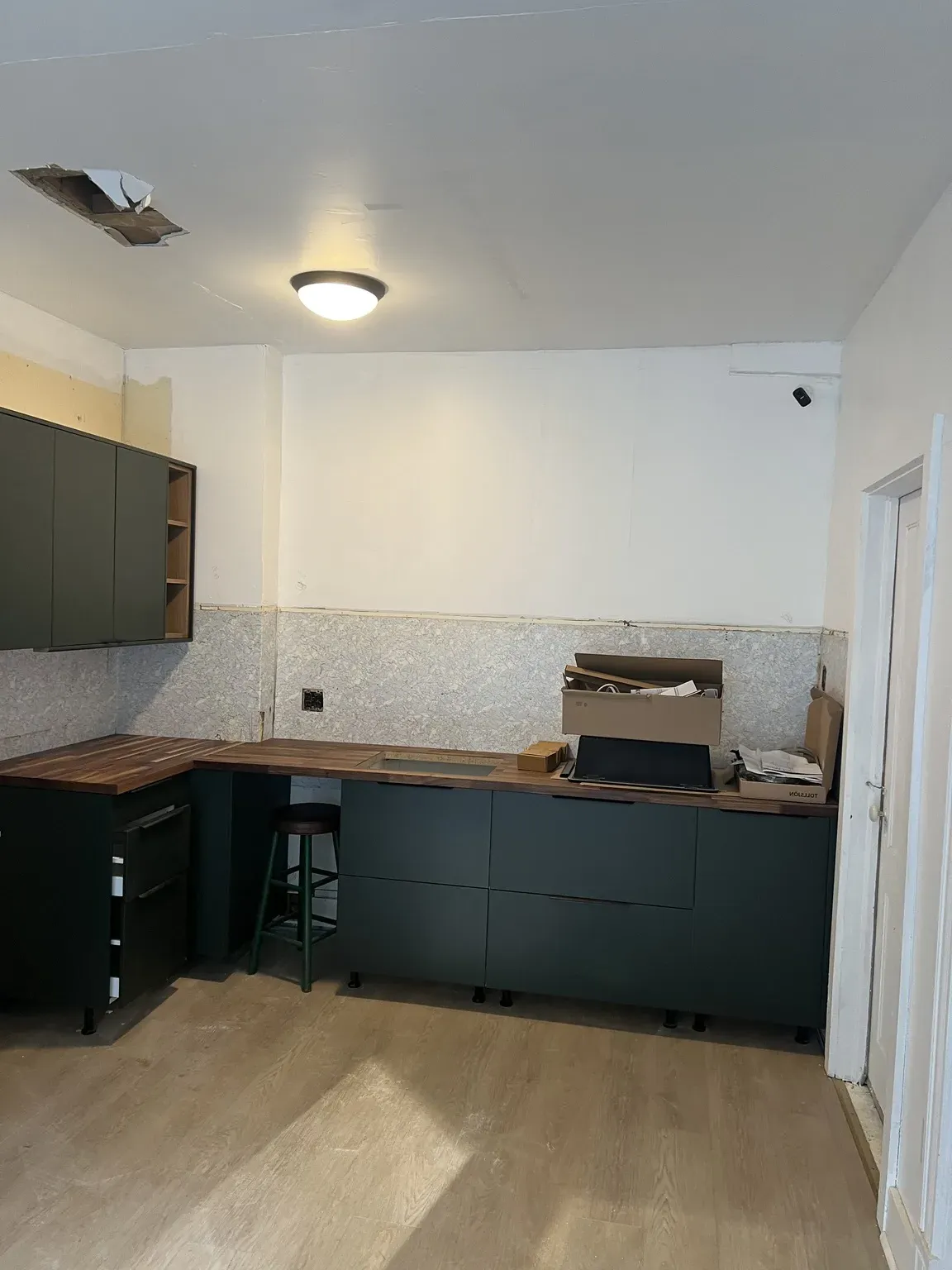
Key takeaways
- IKEA SEKTION works well in pre-war New England homes because adjustable legs, a suspension rail and fillers are built to absorb crooked walls and floors.
- Plaster-and-lath walls need studs located with a magnet and structural screws; never hang cabinets on plaster anchors alone.
- Expect to spend extra time leveling, shimming and scribing; budget an additional half day to a day of installation labor.
- Check for knob-and-tube wiring, galvanized pipes and rot behind old cabinets before the new ones go in.
On this page
- Challenge 1: Uneven Floors
- Challenge 2: Out-of-Plumb Walls
- Challenge 3: Plaster and Lath Walls
- Challenge 4: Non-Standard Dimensions
- Challenge 5: Outdated Plumbing
- Challenge 6: Outdated Electrical
- Challenge 7: Structural Concerns
- Challenge 8: Working with Historic Commissions
- Real Examples from New England
- Tips for Success in Old Homes
- Get Expert Help for Your Old House Kitchen
Old homes are beautiful. They have character, craftsmanship, and history that new construction can't replicate. They also have uneven floors, walls that haven't been plumb since the Eisenhower administration, and plumbing that predates modern building codes.
If you own an older home in Massachusetts, Connecticut, or Rhode Island — and chances are good that you do, given that much of our housing stock dates to before 1950 — installing an IKEA kitchen comes with some unique challenges. The good news is that every one of these challenges has a solution, and IKEA's SEKTION system is actually quite well-suited for older homes thanks to its adjustable design.
At Hearthstone Kitchens, we work in old houses every week. Colonial homes in Lexington, triple-deckers in Somerville, Victorians in Providence, Cape Cods across Connecticut — we've seen it all. Here's everything you need to know.
Challenge 1: Uneven Floors
The Problem
Old houses settle over time. Foundations shift, floor joists sag, and the result is floors that can be off by 1/2 inch, 1 inch, or even more across the span of a kitchen. We've measured kitchens in homes in Salem, MA and Cranston, RI where the floor dropped nearly 2 inches from one end to the other.
The Solution
IKEA's adjustable cabinet legs are your best friend here. SEKTION base cabinets sit on plastic legs that can be adjusted from about 4 inches to 8.5 inches in height. This gives you plenty of range to compensate for uneven floors.
Step by step:
- Find the highest point of the floor in your kitchen
- Set the cabinets at the highest point to the correct height first
- Adjust legs at lower points to bring each cabinet up to the same level
- Use a long level (or laser level) across the tops of all base cabinets to verify
- Use toe kicks to cover the gap between the cabinet bottoms and the floor — the varying heights will be hidden
For severe unevenness (more than 1.5 inches), you may need to:
- Use extended legs or leg extensions
- Build a level base frame (sometimes called a plinth) and set cabinets on that
- Have the floor leveled with self-leveling compound before installation
We have a detailed guide specifically about leveling IKEA cabinets on uneven floors.
When to Level the Floor First
If your floor is more than 1.5 inches out of level, it may be worth leveling it before installation. Self-leveling compound is a relatively affordable fix and makes the entire installation go more smoothly. It's also better for your flooring if you're installing new floors.
Challenge 2: Out-of-Plumb Walls
The Problem
Walls in old houses lean. Sometimes it's barely noticeable — a quarter-inch over 8 feet. Other times, you can practically see it. Out-of-plumb walls affect both base and wall cabinet installation.
The Solution for Wall Cabinets
IKEA's SEKTION suspension rail system handles this beautifully. The suspension fittings on each cabinet allow for in/out adjustment, so you can push a cabinet closer to or further from the wall as needed. Here's the approach:
- Install the suspension rail level across the wall (shim behind the rail where the wall dips away)
- Hang the cabinets on the rail
- Use the in/out adjustment on the suspension brackets to align all cabinets to a uniform plane
- The resulting gap between the cabinet backs and the wall (where the wall dips) is hidden and doesn't affect function
The Solution for Base Cabinets
Base cabinets sit against the wall but are leveled independently. If a wall leans, the base cabinets may have a gap between the back of the cabinet and the wall at either the top or bottom. Solutions:
- Shim behind the cabinet at the point of the gap
- Use filler strips between the cabinet and the wall at visible end points
- Scribe the countertop to the wall — a countertop fabricator can cut the countertop edge to match the wall profile, eliminating the gap at the counter surface
Challenge 3: Plaster and Lath Walls
The Problem
Most homes built before 1950 have plaster and lath walls instead of drywall. Plaster is harder, more brittle, and thicker than drywall. It also makes finding studs and hanging heavy cabinets more complicated.
The Solutions
Finding studs: Electronic stud finders are unreliable through plaster. Instead:
- Use a strong rare-earth magnet to find nails or screws in the lath (these indicate stud locations)
- Drill small exploratory holes at the back of where cabinets will be (the holes will be hidden)
- Knock on the wall and listen for the change from hollow to solid
Drilling through plaster:
- Use a masonry bit to start the hole through the plaster, then switch to a wood bit for the stud
- Drill slowly to avoid cracking the surrounding plaster
- Don't use hammer drill mode — it will shatter plaster
Hanging the suspension rail:
- The rail must be screwed into studs, not just plaster. Use 3-inch or longer screws to penetrate through the plaster, through the lath, and at least 1.5 inches into the stud
- Pre-drill all holes to avoid cracking the plaster
- If a screw location falls between studs, use a heavy-duty toggle bolt rated for the weight
Wall reinforcement: In some cases, especially with deteriorated plaster, we recommend adding a layer of 3/4-inch plywood to the wall behind where the suspension rail will go. This distributes the load and provides a solid mounting surface anywhere you need it. It adds a modest amount to the project cost but provides significant peace of mind.
Challenge 4: Non-Standard Dimensions
The Problem
Old houses don't always follow modern standard dimensions. You might find:
- Ceiling heights of 7'6", 9', 10', or anything in between
- Kitchen doorways that are 28" or 30" wide instead of the standard 32-36"
- Windows at unusual heights
- Walls at odd angles
- Alcoves, chimney bumps, and other irregularities
The Solutions
Non-standard ceiling heights: IKEA offers multiple wall cabinet heights (15", 20", 30", 40"). Mix and match these heights to work with your ceiling. For very high ceilings (9'+), you can stack two rows of wall cabinets, or mount cabinets higher and add open shelving below.
Narrow doorways: Use narrower cabinet widths (12" or 15") near doorways to maintain clearance. IKEA's 12-inch base and wall cabinets are small but functional — great as a transition cabinet next to a door opening.
Unusual layouts: IKEA's modular system actually works well in unusual spaces because you can combine different-width cabinets to fit almost any dimension. A 97-inch wall won't fit standard cabinet sizes perfectly? Try a 36" + 36" + 24" with a 1" filler strip.
Alcoves and bumps: Measure these carefully and treat them as individual wall segments. Cabinets can wrap around bumps using blind corner base cabinets and filler strips.
Challenge 5: Outdated Plumbing
The Problem
Old homes in New England often have:
- Galvanized steel pipes that are corroded and restrictive
- Cast iron drain pipes that may be in poor condition
- Lead supply lines (still found in some pre-1940s homes)
- Non-standard pipe sizes and locations
- No shut-off valves at the sink
The Solutions
We strongly recommend addressing plumbing issues during a kitchen renovation. While the walls are open and the old cabinets are out, it's the most cost-effective time to:
- Test for and replace lead pipes (required by law in many MA/CT/RI communities)
In Massachusetts, Connecticut, and Rhode Island, plumbing work must be done by a licensed plumber and inspected by the local building department. Don't skip this — it protects your home and your family. See our complete plumbing guide for more details.
Challenge 6: Outdated Electrical
The Problem
Older homes may have:
- Knob-and-tube wiring (common in pre-1930s homes)
- Insufficient circuits for modern kitchen appliances
- No GFCI protection on kitchen outlets
- Ungrounded outlets (two-prong)
- Fuse panels instead of circuit breakers
The Solutions
Kitchen electrical in older homes often needs significant updating to meet modern code requirements. At minimum, current code (which applies when you pull a renovation permit) requires:
- Two dedicated 20-amp circuits for kitchen countertop outlets
- GFCI protection for all countertop outlets and any outlets near water
- Dedicated circuits for the refrigerator, dishwasher, and garbage disposal
- Grounded outlets throughout
If your home has knob-and-tube wiring, it will need to be replaced in the kitchen area before new cabinets are installed. A licensed electrician can assess the scope and provide a quote for this work.
For more details, check our kitchen electrical requirements guide.
Challenge 7: Structural Concerns
The Problem
Some old homes have structural issues that affect kitchen renovations:
- Load-bearing walls where you want to open up the floor plan
- Sagging floor joists under the kitchen
- Deteriorated sill plates or foundation walls
- Previous DIY modifications that compromised structural integrity
The Solutions
Before starting any kitchen renovation, check for these structural issues:
- Look in the basement below the kitchen for signs of sagging joists, water damage, or rot
- Check the sill plate (where the framing meets the foundation) for deterioration
- If you plan to remove or modify any wall, have a structural engineer assess whether it's load-bearing
In Massachusetts, Connecticut, and Rhode Island, removing or modifying a load-bearing wall requires a permit and typically a structural engineer's stamp. This adds to the project scope — contact us for a complete estimate.
Sagging floor joists can be sistered (reinforced) or supported with additional posts in the basement. This should be done before heavy cabinets are installed on top.
Challenge 8: Working with Historic Commissions
The Problem
Some older homes — particularly in historic districts — have restrictions on exterior modifications, and sometimes interior ones as well.
What You Need to Know
In New England, historic districts are common in towns like:
- Massachusetts: Boston (Back Bay, Beacon Hill), Salem, Concord, Deerfield, Nantucket
- Connecticut: Litchfield, Essex, Old Saybrook, New Haven (select areas)
- Rhode Island: Newport, Bristol, Providence (College Hill)
Interior kitchen renovations are generally not regulated by historic commissions — they typically only control exterior changes. However, check with your local commission before starting work, especially if:
- The home has a historic preservation easement
- You plan to modify any exterior walls, windows, or doors
- The home is individually listed on the National Register of Historic Places
Real Examples from New England
1830s Colonial in Concord, MA
The floors were nearly 2 inches off level across a 14-foot kitchen. We used extended IKEA legs plus custom plinth blocks to compensate. The wall cabinets required heavy shimming behind the suspension rail. The result was a beautiful AXSTAD white kitchen that looks perfectly level despite the house being anything but.
1910 Triple-Decker in Providence, RI
Plaster walls, 9-foot ceilings, galvanized plumbing, and knob-and-tube wiring. We coordinated with a licensed electrician and plumber to update all systems before installing the IKEA kitchen. The high ceilings allowed for stacked wall cabinets — 30-inch main cabinets with 15-inch cabinets on top, creating a dramatic wall of storage.
1920s Tudor in West Hartford, CT
An arched doorway into the kitchen created an unusual layout constraint. We used a combination of 12-inch and 15-inch base cabinets to work around the arch while maximizing counter space. BODBYN doors in off-white complemented the home's period character.
Tips for Success in Old Homes
- Budget 15-20% extra for unexpected issues. Old homes always have surprises.
- Get a professional measurement before ordering anything.
- Open up walls selectively before finalizing your cabinet order — peek behind the cabinets to check for plumbing, electrical, and structural conditions.
- Don't skip permits. Building inspectors in MA, CT, and RI take unpermitted work seriously, and it can cause problems when you sell the home.
- Hire a plumber and electrician early. Their schedules fill up quickly, and you'll want their rough-in work done before cabinet installation begins.
- Embrace the character. An IKEA kitchen in an old house doesn't have to look anachronistic. Choose door styles that complement the home's era — BODBYN and LERHYTTAN work beautifully in traditional homes.
- Plan for the long term. While the walls are open, address any deferred maintenance. It will never be cheaper or easier than during a kitchen renovation.
Get Expert Help for Your Old House Kitchen
At Hearthstone Kitchens, old houses are our specialty. We understand the unique challenges of installing modern kitchens in historic New England homes, and we have the experience to handle whatever your house throws at us. Contact us for a free consultation — we'll assess your space and give you an honest picture of what your project will involve.
Frequently asked questions
About the authors
This guide was written and reviewed by the Hearthstone Kitchens installation team, who have installed 600+ IKEA kitchens in Massachusetts, Connecticut and Rhode Island over 7+ years. Prices reflect what we see on real quotes in 2026 and are updated when the market moves. We are an independent installer and are not affiliated with IKEA.
Ready to talk about ikea cabinet assembly?
Upload your IKEA plan or a few photos. We will check it for missing pieces and send an itemized estimate within 3 hours, free and with no obligation.