On this page
A good range hood is one of the most important and most under-appreciated kitchen components. It removes cooking fumes, grease, moisture, and odors from your kitchen. Without proper ventilation, your beautiful new IKEA kitchen will accumulate grease film on cabinets and ceilings, moisture can lead to mold growth, and cooking odors linger for hours.
Here's our complete guide to choosing and installing ventilation for your IKEA kitchen.
Ducted vs. Ductless Range Hoods
This is the first and most important decision. The difference is significant.
Ducted (Vented) Range Hoods
A ducted hood pulls air through the filter and exhausts it outside through ductwork that passes through an exterior wall or roof.
Pros:
- Actually removes smoke, steam, grease, and odors from your home
- Much more effective at clearing cooking fumes
- Reduces kitchen moisture (important for preventing mold)
- The only option that truly vents your kitchen
Cons:
- Requires ductwork to an exterior wall or roof
- More expensive to install (ductwork adds cost)
- Not possible in every location (interior kitchens with no nearby exterior wall are challenging)
Ductless (Recirculating) Range Hoods
A ductless hood pulls air through filters (grease filter + charcoal filter) and recirculates it back into the kitchen.
Pros:
- No ductwork needed — can be installed anywhere
- Less expensive to install
- Good option when ductwork is impossible
Cons:
- Does NOT remove odors effectively (charcoal filters help but don't eliminate them)
- Does NOT remove moisture
- Charcoal filters need replacement every 3-6 months, which adds to the ongoing maintenance cost
Our Recommendation: Go Ducted If You Can
The difference in kitchen air quality is dramatic. In New England homes — especially in winter when you're cooking with windows closed — a ducted hood is the difference between a fresh kitchen and one that smells like last night's dinner.
CFM Requirements for Different Cooking Styles
CFM (Cubic Feet per Minute) measures airflow capacity. How much CFM you need depends on your cooking style and range type:
Electric Range or Cooktop
- Light cooking (boiling, steaming): 150-250 CFM
- Regular cooking (sauteing, frying): 250-400 CFM
- Heavy cooking (deep frying, grilling): 400+ CFM
Gas Range or Cooktop
Gas ranges produce more heat and combustion byproducts, requiring more ventilation:
- Standard gas range (up to 40,000 BTU total): 400-600 CFM
- Pro-style gas range (40,000-80,000 BTU): 600-1,200 CFM
- General rule: 1 CFM per 100 BTU of burner output
Island Installation
Hoods over kitchen islands need approximately 50% more CFM than wall-mounted hoods because there are no walls to contain the cooking fumes:
- Multiply the above CFM recommendations by 1.5 for island installations
IKEA Range Hood Options
IKEA offers several ventilation options designed to integrate with SEKTION cabinets:
IKEA Wall-Mounted Hoods
IKEA sells several wall-mounted range hoods in different styles:
- Stainless steel traditional: Classic hood shape, various widths
- Glass and steel modern: Sleek appearance for contemporary kitchens
- Typical CFM range: 200-400 CFM
IKEA Integrated Hoods (Under-Cabinet/Built-In)
These mount under a wall cabinet and are partially concealed:
- EVENTUELL: Built-in extractor hood, recessed under a wall cabinet
- Typical CFM: 200-350 CFM
- Best for: Kitchens where you want the hood to be discreet
IKEA Downdraft
IKEA has offered downdraft ventilation options for cooktops. These rise up from behind the cooktop:
- Best for: Kitchen islands where an overhead hood isn't desired
- CFM: Typically 300-500
- Note: Downdraft systems are less effective than overhead hoods for most cooking
Limitations of IKEA Hoods
IKEA's range hoods are adequate for light to moderate cooking but have limited CFM compared to dedicated ventilation brands. If you're a serious cook or have a high-BTU gas range, consider a non-IKEA hood from:
- Broan: Wide range from budget to mid-range, good availability
- Zephyr: Mid-to-premium range, excellent quiet operation
- BEST by Broan: Premium hoods with high CFM
- Vent-A-Hood: Premium, known for quiet operation
These third-party hoods integrate fine with IKEA cabinets — you just need to plan the cabinet spacing to accommodate the hood width and ductwork.
How to Install Ventilation Ductwork
Duct Route Options
Through an exterior wall (most common):
- The most direct route — ductwork runs from the hood straight back through the wall
- Best for kitchens on exterior walls
- Requires cutting a hole through the exterior wall and installing an exterior vent cap
Through the ceiling and roof:
- Ductwork runs from the hood up through the ceiling, through the attic, and out through a roof cap
- Necessary when the range is not on an exterior wall
- More complex and expensive than wall venting
- The duct run should be as short and straight as possible
Through the ceiling to a soffit:
- Ductwork runs from the hood into the cabinet above, then horizontally through a soffit or the space above cabinets to an exterior wall
- Works when the range is not on an exterior wall but a nearby exterior wall is available
- Horizontal runs should slope slightly upward toward the exit to prevent grease accumulation
Duct Sizing
- 6-inch round or 3.25" x 10" rectangular: Standard for most residential hoods up to 400 CFM
- 8-inch round: Required for hoods over 400 CFM
- Use rigid or semi-rigid metal ductwork: Never use flexible vinyl duct for range hoods — it's a fire hazard (grease buildup + heat). Rigid metal duct is code-required in most jurisdictions.
Installation Basics
- Plan your duct route before cabinet installation
- Cut the wall/ceiling penetration
- Install ductwork from the exterior wall cap inward
- Seal all joints with foil tape (not duct tape — real duct tape deteriorates with heat)
- Insulate ductwork in unheated spaces (attic) to prevent condensation
- Install the exterior vent cap with a damper to prevent backdrafts
Code Requirements
General Requirements
- Kitchen ventilation is required by the International Mechanical Code (adopted with amendments by MA, CT, and RI)
- Minimum ventilation rate varies by code version, but 100 CFM intermittent or 25 CFM continuous is a common baseline
- Ductwork must be rigid metal for range hood exhaust
- Exterior termination required for ducted hoods (no dumping into attics, wall cavities, or crawl spaces)
- Backdraft damper required at the exterior termination
- Ductwork must be accessible for cleaning
Massachusetts Specific
- Must comply with the Massachusetts State Building Code (780 CMR)
- Kitchen ventilation permits are typically included in the overall kitchen renovation permit
- In condos, check your condo association's rules about exterior wall penetrations for ductwork
Connecticut and Rhode Island
- Similar requirements to Massachusetts
- Building code compliance verified by local building inspector
- Permit required for new ductwork installation
Noise Levels and Recommendations
Range hood noise is measured in sones:
- 1-2 sones: Very quiet — comparable to a refrigerator humming. Premium hoods operate here.
- 3-4 sones: Moderate — noticeable but not disruptive. Most good-quality hoods on medium speed.
- 5-7 sones: Loud — comparable to a busy restaurant kitchen. Budget hoods and high-speed operation.
- 8+ sones: Very loud — conversation is difficult
For open floor plans (common in modern New England renovations), aim for a hood that operates at 3 sones or less on its most-used speed setting. See our open floor plan kitchen guide for more on managing noise in open layouts.
Tips for Reducing Hood Noise
- Buy a properly sized hood: An oversized hood can run on lower (quieter) speeds and still be effective
- Use smooth, rigid ductwork: Flexible duct and rough interior surfaces create turbulence noise
- Keep duct runs short and straight: Every elbow and foot of duct adds noise
Integration with IKEA Cabinet Sizing
Wall-Mounted Hoods
A wall-mounted hood typically replaces the wall cabinet above the range. IKEA wall cabinets are 15, 18, 24, 30, or 36 inches wide. Make sure your hood width matches the cabinet opening:
- 30-inch range: Use a 30-inch hood (minimum) — a 36-inch hood is better
- 36-inch range: Use a 36-inch hood (minimum) — a 42-inch hood is better for gas
Under-Cabinet / Integrated Hoods
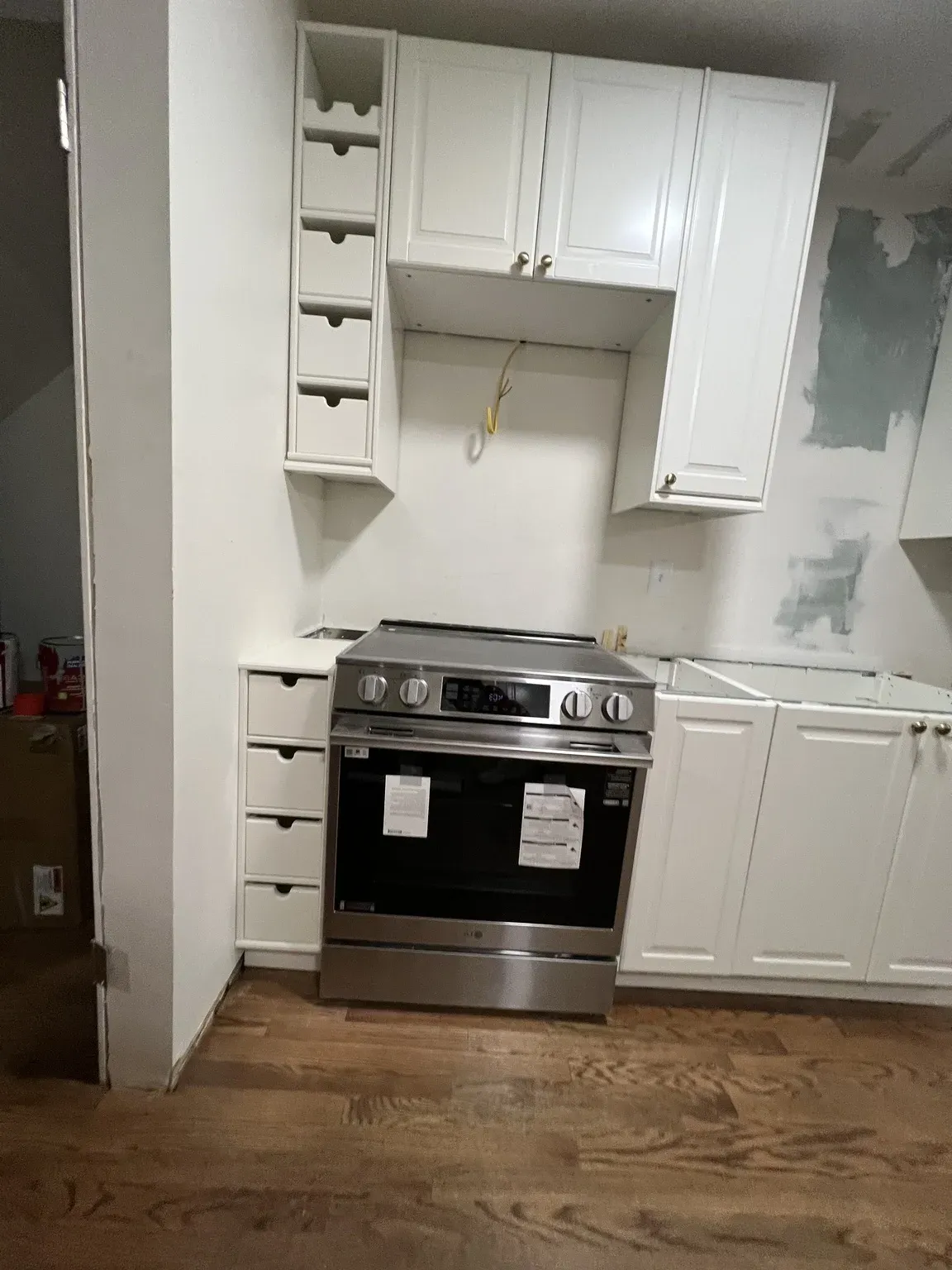
IKEA's integrated hoods mount under a wall cabinet. The cabinet above must be deep enough to conceal the hood body and provide space for the duct connection. Typically, you need a cabinet that's at least 12 inches deep (IKEA's standard wall cabinet depth is 15 inches for SEKTION, which is sufficient).
Hood Height Above Cooktop
- Electric cooktop: 24-30 inches above the cooking surface
- Gas cooktop: 27-36 inches above the cooking surface (check manufacturer recommendations)
- Standard IKEA installation places the bottom of wall cabinets at 54 inches from the floor (18 inches above a 36-inch counter). This may need to be adjusted based on your hood's recommended mounting height.
Get the Ventilation Right
Ventilation is one area where cutting corners has lasting consequences. A poorly ventilated kitchen accumulates grease, moisture, and odors that affect your cabinets, walls, and air quality for years. At Hearthstone Kitchens, we plan ventilation as part of every IKEA kitchen design, making sure you have the right hood, the right ductwork, and proper code compliance. Contact us to include ventilation planning in your kitchen project.
About the authors
This guide was written and reviewed by the Hearthstone Kitchens installation team, who have installed 600+ IKEA kitchens in Massachusetts, Connecticut and Rhode Island over 7+ years. Prices reflect what we see on real quotes in 2026 and are updated when the market moves. We are an independent installer and are not affiliated with IKEA.
Ready to plan your IKEA kitchen?
Upload your IKEA plan or a few photos. We will check it for missing pieces and send an itemized estimate within 3 hours, free and with no obligation.