Key takeaways
- Inventory the delivery against the item list the day it arrives, photograph every problem, and report to IKEA the same day.
- Fronts, panels, toe kick and hardware can be fitted on a return visit; a missing sink base, corner cabinet, suspension rail or frame hardware stops that part of the job.
- Replacements go through IKEA: small hardware is often available in store at Stoughton or New Haven, larger items are reordered, and the process changes, so check current terms.
- A good installer inventories before building, tells you in writing what is short, and reschedules only the affected portion.
- Rhode Island customers and winter deliveries have less slack, so the same-day check matters more there.
Cost
$0; IKEA replaces defective or missing parts
Time
1–2 hours to inventory a delivery
Difficulty
Easy
Tools
Order list, phone camera, a dry staging area
On this page
- Why IKEA kitchen deliveries come up short
- How to inventory a delivery the day it arrives
- What counts as damage worth reporting
- How IKEA replacement generally works
- What an installer can work around, and what stops the job
- How to sequence installation around a missing part
- Receipts, photos and paperwork
- How good installers protect you
- The New England angle: Rhode Island, winter and split deliveries
- What to do next
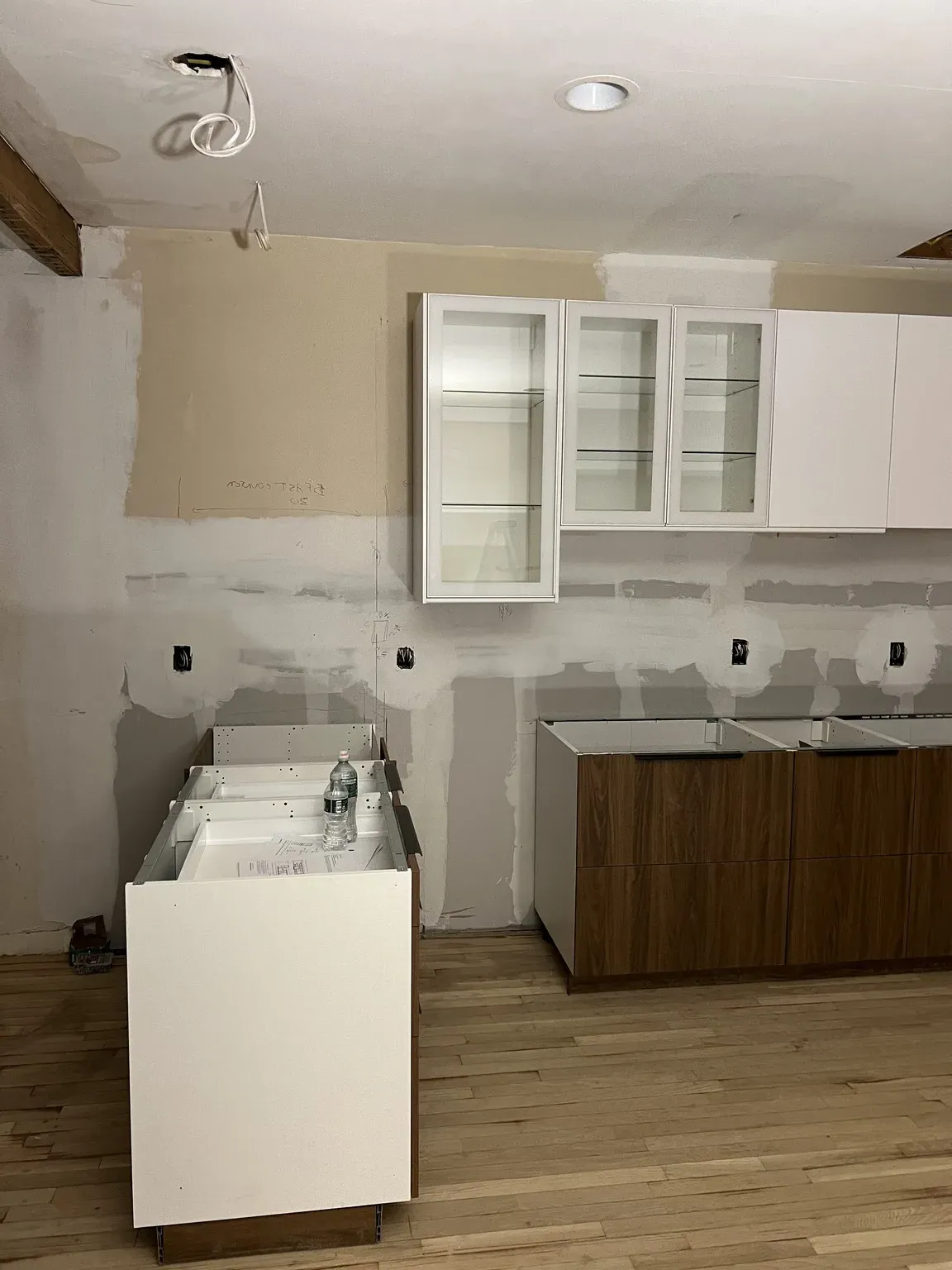
Inventory the delivery the day it arrives, report anything missing or damaged to IKEA the same day, and tell your installer before installation day. Do those three things and a short delivery is an inconvenience, not a crisis: most IKEA kitchens can be installed around one or two missing parts, and the replacement gets fitted on a short return visit. Skip them and the same missing box can cost you a rescheduled crew, a week without a kitchen, and an argument about who noticed what.
We have opened a lot of IKEA boxes across Massachusetts, Connecticut and Rhode Island. Something is wrong in a fair share of deliveries, usually small, occasionally not. Here is how we handle it and how to protect yourself.
Why IKEA kitchen deliveries come up short
A kitchen order is not one product. A modest 10x10 kitchen arrives as somewhere between 60 and 150 separate boxes and bags: frames, doors, drawer fronts, drawer boxes, hinge packs, leg packs, cover panels, toe kick, rail, shelves, and a dozen kinds of fitting. Each is picked from a warehouse shelf, staged, loaded, driven, unloaded and carried into your house. Every step is a chance for one line to fall off.
The common causes we see:
- Picking errors. A 24-inch frame pulled instead of a 30, a VEDDINGE door in the wrong height, a hinge pack short by one.
- Split shipments. Large orders and out-of-stock items ship separately, sometimes days apart, and the first truck's paperwork does not always make that clear.
- Handling damage. Frames and doors travel flat and heavy; corners get crushed against pallet edges, and a box that looks fine can have a cracked panel inside.
- Substitutions and backorders. A discontinued color, a front that is out of stock regionally, a part that quietly drops off the order at checkout.
- Miscounts at the door. Delivery crews count boxes, not contents. If your list says 112 and they hand you 111, nobody knows which one is gone until you open everything.
None of this is unique to IKEA; every flat-pack system has the same failure points. It is simply the reason the inventory step exists. For what to expect from the delivery itself, from scheduling to where the truck can park, see our IKEA kitchen delivery guide.
How to inventory a delivery the day it arrives
Do this before the delivery crew leaves if you can, and no later than that evening. You need your printed item list, a pen, your phone, and a clear patch of floor.
- Count boxes against the delivery note before signing. The driver's paperwork lists a box count. Match it. If it is short, write the shortage on the delivery note before you sign, and photograph the note.
- Photograph the pile as it stands. Two or three wide shots of the delivered stack, including any visibly crushed boxes, before anything is moved. These are your evidence of condition on arrival.
- Sort by category, not by room. Frames in one area, doors and fronts in another, hardware bags and small boxes together, panels and rail on their own. This alone reveals most shortages.
- Tick every line on the item list. Each box carries a label with the article name, size and eight-digit article number. Match it to the list and tick the quantity. Do not tick by memory; two 15x30 doors and two 15x40 doors look identical in the box.
- Open the boxes that matter most. Every door and drawer front, every cover panel, and the sides of every frame. Fronts are what you will look at for twenty years; a chipped edge on a VOXTORP high-gloss door is not something to discover on installation day.
- Check hardware bags for completeness. Hinge packs, leg packs, drawer runner bags. Count the pieces against the quantity printed on the bag. A missing bag of cam locks stops a frame build.
- List every problem with the article number, quantity and a photo. One line per issue. This becomes your report to IKEA and your message to your installer.
- Report the same day. Through IKEA's customer service channels, with your order number and the list. The sooner the report, the sooner replacements ship and the less room for a dispute about when damage happened.
- Send the list to your installer. Even if it is two lines. It changes how we plan the first day.
If you are not sure how to read the item list, our guide to reading your IKEA kitchen plan and order list walks through every category on it.
What counts as damage worth reporting
Report anything that will show, anything structural, and anything that cannot be built without.
- Dents and gouges in doors and drawer fronts. Any mark you can feel with a fingertip on a visible face. Painted fronts like BODBYN and AXSTAD show chips at the edges; high-gloss VOXTORP shows scratches; foil-wrapped fronts can bubble or peel at a crushed corner.
- Crushed corners on frames. A frame is particleboard with a melamine face. A crushed corner will not hold a cam lock or a hinge plate securely, and the crack often runs further than it looks.
- Chipped or cracked cover panels and toe kick. These are the finish pieces at eye level and floor level. There is no hiding them.
- Bowed or warped panels. Lay long panels and doors on a flat floor. A door that rocks on the floor will not sit flush on the cabinet.
- Missing or short hardware bags. Hinges, legs, cam locks, dowels, drawer runners, rail brackets. Small, cheap and completely job-stopping.
- Wrong item. Right style, wrong size or color. Treat it as missing.
What generally does not need a report: scuffs on the outside of the cardboard, a torn box with intact contents, minor marks on frame surfaces that will be hidden by a neighboring cabinet or a cover panel. Note them, but use your judgment. A frame side that will be covered anyway is not worth waiting two weeks for.
How IKEA replacement generally works
At the time of writing, replacements go through IKEA, not through your installer and not through the delivery company. The general pattern:
- You report the missing or damaged items with your order number, article numbers and photos, through IKEA customer service.
- Small hardware is often available in store. Hinges, legs, cam locks, dowels and similar fittings can usually be picked up at the returns or spare-parts desk. For this region that means IKEA Stoughton in Massachusetts or IKEA New Haven in Connecticut. Rhode Island has no store, so it is a drive either way.
- Larger items are reordered. Frames, doors, panels and drawer boxes are generally shipped as a replacement order or made available for pickup. Lead time depends on stock, and a front in a less common color can take longer.
- Damaged goods are sometimes collected, sometimes not. Keep the damaged item and its box until IKEA tells you what to do with it.
Terms, channels and timelines change; check with IKEA for the current process. Our IKEA kitchen warranty guide explains where delivery damage ends and the product warranty begins, which matters if a defect surfaces later.
What an installer can work around, and what stops the job
Almost every installation can start with something missing. The question is what.
| Part type | Can installation proceed? | Typical fix |
|---|---|---|
| One door or drawer front | Yes | Install the cabinet, hang the front on a short return visit; hinges can be pre-mounted |
| Cover panel | Yes | Install the run, fit the panel when it arrives; leaves a bare frame side temporarily |
| Toe kick | Yes | Everything above it proceeds; toe kick clips on last anyway |
| Filler piece | Usually | Run is set with the gap planned; filler scribed in later |
| Handles and knobs | Yes | Drill and fit on the return visit; keep the template |
| Interior shelves, organizers | Yes | Cabinet functions without them; drop in later |
| Drawer box (one or two) | Yes | Frame and other drawers go in; missing box slotted in later |
| Hinges (a pack short) | Partly | Build proceeds; a few doors wait for hardware, often same-week from the store |
| Legs (a pack short) | Partly | Cabinets without legs cannot be leveled; borrow from a later wall, or wait |
| A base frame in the middle of a run | No, for that wall | The run cannot be set or leveled around a hole, and the countertop cannot be templated |
| A wall frame in a run | Partly | Rail goes up and neighbors hang; a gap is left, but alignment is harder after the fact |
| Corner cabinet or corner interior | Usually not | Both runs key off the corner; setting them without it risks rework |
| Sink base | No, for that wall | Everything on that wall depends on where the sink sits |
| Tall pantry or oven housing | Depends | Freestanding tall units can wait; ones tied into a run or a bulkhead cannot |
| Suspension rail | No, for uppers | Nothing hangs without it; base cabinets can proceed |
| Cam locks, dowels, frame hardware | No, for that cabinet | Cheapest part on the list and the most common job-stopper; usually in stock in store |
The pattern: fronts and finish pieces can wait, structure cannot. A missing door costs a return trip. A missing sink base costs a rescheduled wall.
How to sequence installation around a missing part
If you tell us before installation day, we reorder the work so the missing piece lands last.
- Start on the wall that is complete. If the sink wall is short a frame but the range wall has everything, day one moves to the range wall.
- Set the rail and hang every upper that is present. Uppers are independent of the base run and are usually all there.
- Build every frame that has its hardware. Assembly can run ahead of installation; a stack of built frames in the dining room is not a problem.
- Leave the gap sized, not guessed. Where a base frame is missing, we set its neighbors to the plan dimension and brace the gap so the run stays true when the frame arrives.
- Hold countertop templating if the missing part is structural. A fabricator cannot template a run with a hole in it. For a laminate or butcher block top this may be a week's delay; for quartz it pushes the whole tail of the project. See IKEA kitchen quartz countertops for why templating timing matters.
- Fronts, panels and hardware go on last, in one return visit. We batch every late item into a single trip rather than coming back for each one.
The installation-day sequence itself, what happens in what order and what we need from you, is in our IKEA kitchen installation day guide.
Receipts, photos and paperwork
Keep everything until the kitchen is finished and you have lived with it for a month.
- The original order confirmation and item list, printed.
- The signed delivery note, with any shortage written on it.
- Photos of the delivered stack, of every damaged item in its box and out of it, and of the label on each damaged box.
- Your report to IKEA and any case or reference number they give you.
- Replacement order confirmations.
- The installer's delivery inventory, if they do one.
Store the damaged parts and their boxes too, out of the way, until IKEA confirms whether they want them back. If we are handling packaging cleanup on your job, we set damaged items and their labeled boxes aside rather than hauling them out with the cardboard. Photos with the article number label visible are what settle a disagreement; a description of a "chipped white door" settles nothing when your list has fourteen white doors on it.
How good installers protect you
An installer who has done this before does not start a kitchen on faith. Here is what we do, and what you should expect from anyone you hire.
- We ask for the item list and the delivery status before we schedule. If the order is split, we want to know what is on the second truck.
- We inventory before we start. On the morning of day one, or the day before on larger jobs, we check the boxes against the list before a single frame is built. If you have already done it, we spot-check. It takes about an hour and it has saved us many wasted days.
- We tell you what is missing and what it means, in writing. Which parts, whether they stop anything, and what the plan is.
- We reschedule the affected portion, not the whole job. If a corner cabinet is missing, we install everything that does not depend on the corner, then come back once for the corner and the fronts. We do not disappear for three weeks because one box did not show.
- We do not build damaged parts into your kitchen. A crushed frame corner gets flagged, not screwed in and hidden behind a panel.
- Our workmanship warranty covers our work for five years, and it is much easier to stand behind work when the parts were right to begin with.
Our cabinet assembly and installation service includes the inventory check as a matter of course; ask any installer you are considering whether theirs does. It is also on our IKEA kitchen installation checklist, which is worth running through the week before delivery.
The New England angle: Rhode Island, winter and split deliveries
Two regional realities make the inventory habit more important here than it might be elsewhere.
Rhode Island has no IKEA store. A Providence or Warwick customer who is short a hinge pack cannot swing by on a lunch break; the nearest counters are Stoughton, Massachusetts and New Haven, Connecticut, each a real drive. That makes the same-day inventory the difference between one planned trip and three unplanned ones, and it makes the replacement delivery itself the safest path for anything large. We plan Rhode Island jobs with that in mind, and we often combine a parts pickup with our own trip down. See our Rhode Island installation page for how we schedule there.
Winter compresses everything. Delivery windows in January and February are subject to storms, trucks run late, and a replacement order that would take a week in May can take longer when the roads are bad. Cold also matters for the parts: a door that has spent a day in an unheated truck should sit inside for a day before it is installed or judged for warp. Our guide to IKEA kitchens and New England weather covers acclimating materials and scheduling around the season.
Split shipments are the norm for large orders. A 30-cabinet kitchen for a colonial in West Hartford or a big Cape in Falmouth often arrives on two trucks. Know that before the first one comes so you are not reporting an absence that is scheduled for Thursday.
What to do next
Print the item list before the truck arrives. Count, sort, open, tick, photograph, report, all the same day. Then tell your installer what is short, and let them sequence around it.
If you would like a crew that does the inventory with you and builds the schedule to absorb a missing part rather than collapse under it, request a free estimate. Send the item list and your delivery date, and we will tell you what to check first.
Frequently asked questions
About the authors
This guide was written and reviewed by the Hearthstone Kitchens installation team, who have installed 600+ IKEA kitchens in Massachusetts, Connecticut and Rhode Island over 7+ years. Prices reflect what we see on real quotes in 2026 and are updated when the market moves. We are an independent installer and are not affiliated with IKEA.
Ready to talk about ikea cabinet assembly?
Upload your IKEA plan or a few photos. We will check it for missing pieces and send an itemized estimate within 3 hours, free and with no obligation.