Key takeaways
- Day one starts with a full inventory of boxes against the order list, then the suspension rail and base cabinets.
- Doors, drawer fronts and handles go on last, after every cabinet is level and secured, so alignment is done once.
- Someone reachable by phone for decisions saves hours; nobody needs to be home all day.
- Countertop templating happens after installation, so the kitchen will be functional but topless for one to two weeks if you chose stone or quartz.
Cost
Included in installation
Time
1–7 days on site
Difficulty
Hire a pro
Tools
Be reachable by phone; clear the room
On this page
- Before Installation Day: What You Should Have Ready
- Hour 1-2: Arrival, Setup, and Wall Rail Installation (8:00-10:00 AM)
- Hour 2-4: Base Cabinet Assembly and Installation (10:00 AM-12:00 PM)
- Hour 4-5: Lunch Break and Wall Cabinet Assembly (12:00-1:00 PM)
- Hour 5-7: Wall Cabinet Installation (1:00-3:00 PM)
- Hour 7-9: Doors, Drawers, and Adjustment (3:00-5:00 PM)
- Hour 9-10: Finishing Touches and Cleanup (5:00-6:00 PM)
- What the Homeowner Should Do
- After Installation Day
After weeks of planning, designing, ordering, and waiting, installation day is finally here. Your IKEA boxes are stacked in the garage or living room. The old kitchen has been demolished (or is about to be). You are equal parts excited and anxious.
We get it. Having strangers in your home tearing apart and rebuilding one of the most important rooms in the house is a big deal. Knowing what to expect makes the whole experience much less stressful. Here is a detailed, honest walkthrough of what a typical IKEA kitchen installation day looks like when done by a professional team.
Note: We are describing a full professional installation here. A DIY installation will take significantly longer — typically 3-5 times as long — and the sequence may differ.
Before Installation Day: What You Should Have Ready
The success of installation day depends heavily on what happens before the installers arrive:
The kitchen should be cleared. Old cabinets removed, countertops gone, walls patched and painted (or at least primed). The room should be empty and ready for new cabinets.
IKEA boxes should be sorted and accessible. Ideally, sort your boxes by cabinet location and type. This saves the installers significant time searching through piles of flat-pack boxes. See our installation checklist for complete pre-installation preparation.
Walls should be in good condition. Drywall should be solid and smooth. Plaster walls in older New England homes should be checked for stability — if the plaster is loose or crumbling, it needs repair before cabinets are mounted.
Floor should be finished. IKEA base cabinets sit on adjustable legs on top of the finished floor. If you are installing new flooring, it should be done before the cabinets. The exception is some tile installations where tiling up to the cabinet legs is acceptable.
Plumbing and electrical rough-in should be complete. Water supply lines, drain pipes, and electrical outlets should be in their final positions based on the kitchen plan. The installers are not plumbers or electricians (though at Hearthstone Kitchens, we coordinate all trades).
Hour 1-2: Arrival, Setup, and Wall Rail Installation (8:00-10:00 AM)
8:00 AM — Arrival and walkthrough. The installation team arrives (typically 2-3 people for a full kitchen). They do a walkthrough of the space, review the installation plan, and verify measurements against the actual room. They will note any concerns — an out-of-plumb wall, an unexpected pipe location, or a floor that is not level.
8:30 AM — Protect the space. Drop cloths go down on the floor. Adjacent rooms and hallways are protected. If there are doorways that will see heavy traffic (carrying cabinets in), the frames are padded.
9:00 AM — Install the suspension rail (wall rail). This is the backbone of an IKEA kitchen installation. The SEKTION system uses a metal rail that is screwed into the wall studs along the line where wall cabinets will hang. The rail must be perfectly level — if it is off, every cabinet above it will be off.
The installers use a laser level to mark a perfectly level line across the wall, then mount the steel rail using heavy-duty screws driven directly into wall studs. In older New England homes with plaster-and-lath walls, stud finding can be tricky. Professional installers use multiple methods (stud finder, magnet, small drill holes) to verify stud locations before committing.
A second rail is installed lower on the wall for the base cabinets (or the base cabinets are leveled on their adjustable legs — the approach depends on installer preference and floor conditions).
This step takes about 1-2 hours and is the most critical part of the entire installation. If the rails are not level and securely attached, nothing else will line up correctly.
Hour 2-4: Base Cabinet Assembly and Installation (10:00 AM-12:00 PM)
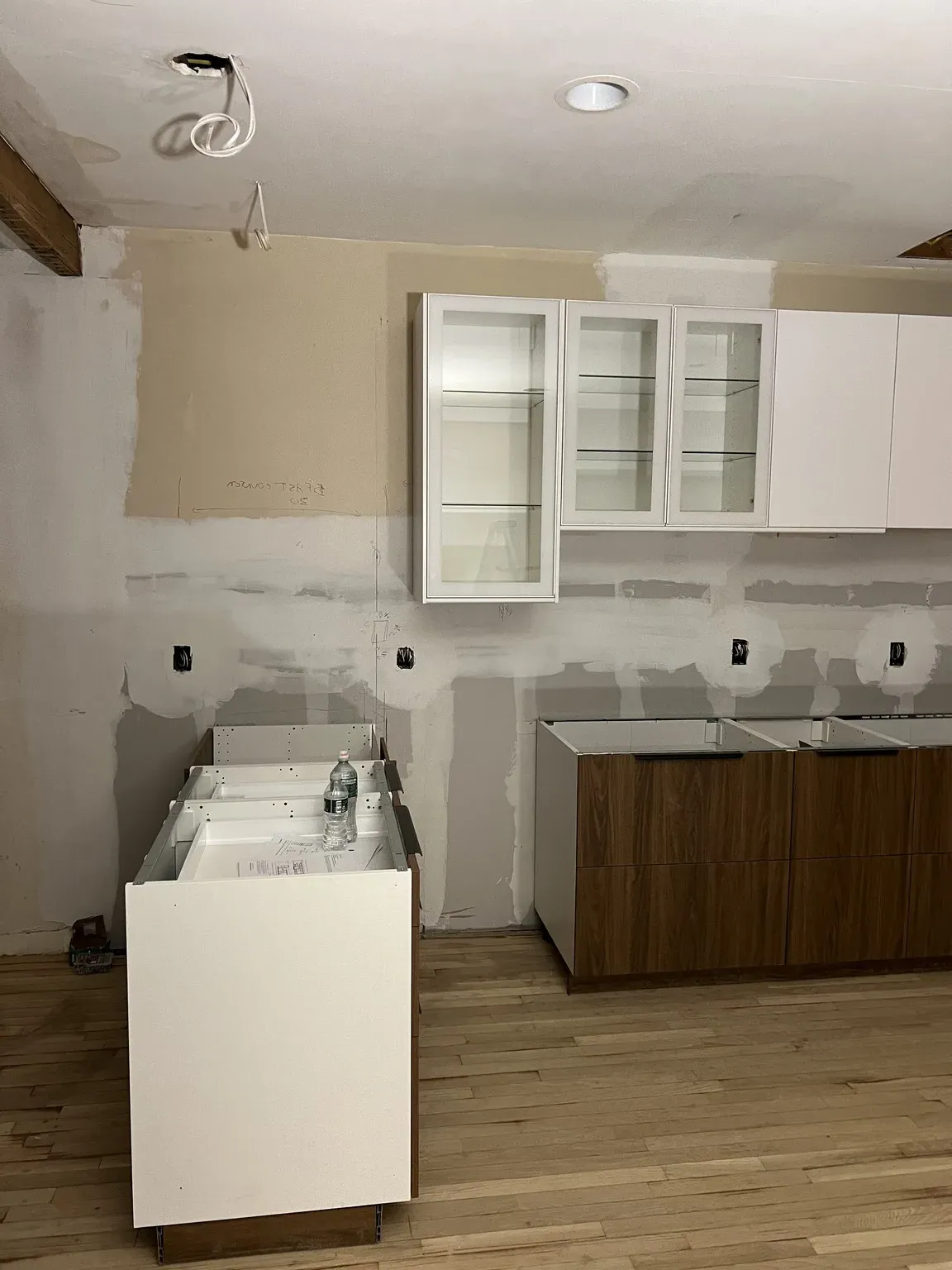
10:00 AM — Base cabinet assembly. If cabinets were not pre-assembled (some installers pre-assemble the day before), assembly begins. IKEA SEKTION base cabinets come flat-packed with all hardware. An experienced installer can assemble a base cabinet in 10-15 minutes.
11:00 AM — Base cabinet installation. Base cabinets are placed in position starting from a corner (for L-shaped kitchens) or from one end of a straight run. Each cabinet is:
- Set on its adjustable legs
- Leveled using a precision level (front-to-back and side-to-side)
- Connected to adjacent cabinets with included joining hardware
- Secured to the wall
Leveling is painstaking work, especially on older floors that sag or slope. The adjustable legs give about 2 inches of range, which is usually sufficient but occasionally requires creative solutions (like shimming the legs or building up the floor locally).
A typical L-shaped kitchen has 6-10 base cabinets. Expect this step to take 2-3 hours for assembly and installation.
Hour 4-5: Lunch Break and Wall Cabinet Assembly (12:00-1:00 PM)
12:00 PM — Lunch. The crew takes a break. The homeowner often peeks in to check progress and is usually impressed — seeing the base cabinets in place gives the first real sense of what the kitchen will look like.
12:30 PM — Wall cabinet assembly. While the base cabinets settle (yes, there can be minor settling as the legs compress under weight), the team begins assembling wall cabinets. Wall cabinets are lighter and simpler than base cabinets, but there are usually more of them.
Hour 5-7: Wall Cabinet Installation (1:00-3:00 PM)
1:00 PM — Hanging wall cabinets. Using the suspension rail installed earlier, wall cabinets are hung one at a time. Each cabinet hooks onto the rail and is adjusted using built-in screws that control height and depth. Cabinets are then joined to each other and fine-tuned for alignment.
This is the step where the kitchen really starts to come together. Seeing the wall cabinets up and aligned with the base cabinets below gives the complete picture of the kitchen layout.
Height adjustments: The rail system allows precise vertical adjustment without removing the cabinet from the wall. This is one of the advantages of IKEA's mounting system — traditional face-frame cabinets require lifting the entire cabinet to adjust height.
Common issue at this stage: If the ceiling is not level (very common in older homes across MA, CT, and RI), the gap between the top of the wall cabinets and the ceiling will vary. This is addressed later with crown molding, soffits, or filler panels.
Hour 7-9: Doors, Drawers, and Adjustment (3:00-5:00 PM)
3:00 PM — Install drawer systems. MAXIMERA drawers are assembled and installed in the base cabinets. This includes the drawer boxes, slides, and soft-close mechanisms. Each drawer is tested for smooth operation.
3:30 PM — Hang doors. Cabinet doors are mounted on their hinges — IKEA uses a clip-on hinge system that makes door installation relatively quick. Each door is hung and then adjusted using the three-axis hinge adjustment (up/down, left/right, in/out) to achieve perfect alignment with adjacent doors.
Door alignment is an art. Getting every door perfectly flush, with even gaps between them, requires patience and a good eye. This is one of the areas where professional installation truly outshines DIY — a professional installer will spend 30-45 minutes fine-tuning door alignment until every gap is consistent and every door sits perfectly flat when closed.
4:30 PM — Install interior organizers. Drawer dividers, pull-out trash systems, shelf clips, and other interior fittings are installed.
Hour 9-10: Finishing Touches and Cleanup (5:00-6:00 PM)
5:00 PM — Toe kicks and filler panels. Toe kick panels are cut to length and snapped into place. Filler panels are cut, scribed to walls if necessary, and installed. Cover panels are applied to any exposed cabinet sides.
5:30 PM — Final check and adjustment. The lead installer does a thorough walkthrough:
- Every door opened and closed (checking alignment and soft-close)
- Every drawer pulled out and pushed back (checking smooth operation)
- All cabinets checked for level
- Fillers and toe kicks inspected for gaps
- Cabinet interiors checked for any missing hardware
5:45 PM — Cleanup. All packaging materials, cardboard, and debris are collected. The floor is swept or vacuumed. The workspace is left clean.
6:00 PM — Walkthrough with homeowner. The installer walks you through the completed cabinet installation, demonstrates any features you might not be familiar with (soft-close adjustment, drawer removal for cleaning, etc.), and notes any follow-up items.
What the Homeowner Should Do
Before installation day:
- Clear the kitchen completely
- Set up a temporary kitchen station elsewhere (a table with a microwave, coffee maker, and disposable plates goes a long way)
- Make sure there is clear access for the installers to bring in cabinets
During installation day:
- Be available for questions (the installer may need decisions about filler placement, handle locations, or other details)
- Stay out of the work area (it is a construction zone with tools, screws, and heavy cabinets)
- Keep children and pets away from the workspace
- Offer water and point out the bathroom — small courtesies go a long way
What NOT to do:
- Do not hover. Trust your installer. Watching every screw go in raises everyone's anxiety.
- Do not make design changes mid-installation. If you suddenly decide you want the corner cabinet on the other side, that is a major redesign, not a small adjustment.
- Do not skip the final walkthrough. This is your chance to flag any concerns before the team leaves.
After Installation Day
The cabinet installation is complete, but your kitchen is not finished yet. Next steps typically include:
- Countertop template (scheduled 1-3 days after cabinet installation)
- Countertop fabrication and installation (1-3 weeks after template)
- Plumbing finish (sink, faucet, dishwasher connection — after countertops)
- Electrical finish (under-cabinet lighting connection, outlet installation)
- Backsplash (after countertops)
- Hardware installation (handles and knobs — can be done anytime)
The complete timeline from cabinet installation to fully finished kitchen is typically 2-4 weeks, depending on countertop fabrication time and trade availability.
At Hearthstone Kitchens, we manage this entire timeline for our clients across Massachusetts, Connecticut, and Rhode Island. From the first wall rail screw to the last handle installation, we coordinate every step so you know exactly what is happening and when.
Schedule your installation with our team and experience a stress-free kitchen renovation.
Frequently asked questions
About the authors
This guide was written and reviewed by the Hearthstone Kitchens installation team, who have installed 600+ IKEA kitchens in Massachusetts, Connecticut and Rhode Island over 7+ years. Prices reflect what we see on real quotes in 2026 and are updated when the market moves. We are an independent installer and are not affiliated with IKEA.
Ready to talk about ikea cabinet assembly?
Upload your IKEA plan or a few photos. We will check it for missing pieces and send an itemized estimate within 3 hours, free and with no obligation.