Key takeaways
- The checklist runs in four phases: before you order, before delivery, before installation day and after installation.
- The two items that prevent the most trouble are a professional plan review before ordering and a box-by-box inventory on delivery day.
- Plumbing and electrical rough-in, demolition and wall repair should all be finished before installation starts.
- Keep the order list, receipts and photos together; you will need them for missing parts and warranty claims.
Cost
Free
Time
Plan 4–8 weeks from order to cooking
Difficulty
Easy
Tools
This checklist, your order list, a calendar
On this page
After installing hundreds of IKEA kitchens across New England, we have learned that the projects that go smoothly have one thing in common: preparation. The homeowners who take the time to plan, verify, and prepare before installation day have fewer surprises, shorter timelines, and better results.
We created this checklist based on everything we have learned. It covers every phase of an IKEA kitchen project, from the first measurements to the final walkthrough. Bookmark it, print it, and check off each item as you go.
Phase 1: Pre-Design (2-4 Weeks Before Design)
These items lay the groundwork for a successful design:
-
Set a realistic total budget (cabinets + countertops + installation + plumbing + electrical + flooring + backsplash + appliances + contingency). See our financing guide for budgeting frameworks.
-
Measure your kitchen accurately. Measure every wall at three heights (top, middle, bottom). Measure ceiling height in multiple spots. Note window locations, door openings, and any obstructions. Record plumbing and electrical locations.
-
Check walls for plumb and floors for level. Use a 4-foot level. Note any deviations — this information is critical for the design and installation.
-
Identify structural elements. Note where load-bearing walls are. If you plan to remove any walls or modify the layout, consult a structural engineer first. Many older New England homes have load-bearing walls that are not obvious.
-
Research your home's electrical and plumbing. Know what kind of wiring you have (romex, knob-and-tube, BX). Know your plumbing material (copper, PEX, galvanized). This affects the scope and cost of rough-in work.
-
Check local permit requirements. In Massachusetts, Connecticut, and Rhode Island, kitchen renovations that involve plumbing, electrical, or structural changes typically require permits. Check with your local building department.
-
Browse IKEA door styles online and in person. Visit the IKEA store in Stoughton, MA (or order door samples online) to see finishes in person. Colors look different on screen than in real life.
-
Decide on your must-haves and nice-to-haves. Write down what matters most: more storage? Better layout? Modern look? Resale value? This guides every design decision.
Phase 2: Design (2-4 Weeks)
-
Create an initial design in IKEA's Kitchen Planner or work with a designer. Input your measurements and experiment with layouts.
-
Select your door style and color. See our color guide for help choosing.
-
Plan the work triangle. Position the sink, range, and refrigerator for efficient workflow. See our L-shape or galley guides for layout-specific advice.
-
Choose corner cabinet solutions. See our corner cabinet guide.
-
Select interior organizers. Drawer dividers, pull-out trash, corner carousel, etc. See our organizer guide. Plan these now — they affect cabinet configurations.
-
Plan for appliances. Verify dimensions for every appliance. See our appliance compatibility guide.
-
Plan lighting. Decide on under-cabinet, in-cabinet, and ambient lighting. See our lighting guide.
-
Decide on countertop material and get preliminary quotes. If using quartz, contact 2-3 fabricators for ballpark pricing.
-
Plan the ceiling treatment. Stacking cabinets, soffit, crown molding, or filler panel. See our ceiling extension guide.
-
Get a professional design review. Even if you designed it yourself, have a professional check for errors, missed fillers, and optimization opportunities. Contact Hearthstone Kitchens for a free design review.
-
Finalize cabinet and accessory list. Double-check every item, quantity, and dimension.
Phase 3: Ordering (1-2 Weeks)
-
Check for upcoming IKEA kitchen sale events. Sales happen 2-3 times per year and can save 15-20%.
-
Order all cabinets, doors, drawers, hardware, and accessories. Use the IKEA order list generated by the Kitchen Planner.
-
Order 10-15% extra filler panels and cover panels. Older New England homes almost always need more fillers than planned.
-
Order extra toe kick material. Better to have too much than too little.
-
Order a few spare doors and drawer fronts in your chosen style. Store these for future repairs.
-
Choose delivery or pickup. IKEA delivery to your home is convenient but check lead times. Pickup from Stoughton can be faster if you have a large enough vehicle (rent a cargo van if needed).
-
Inspect all items upon delivery. Check for damage and missing items immediately. IKEA's return/exchange process is much easier if you flag issues right away.
-
Organize and sort boxes by cabinet type/location. Label each box with its destination in the kitchen (e.g., "corner base," "wall cab - left of sink"). This saves enormous time on installation day.
Phase 4: Pre-Installation (1-2 Weeks Before Install)
-
Hire and schedule your installation team. Book well in advance — good IKEA installers in New England are busy, especially spring through fall.
-
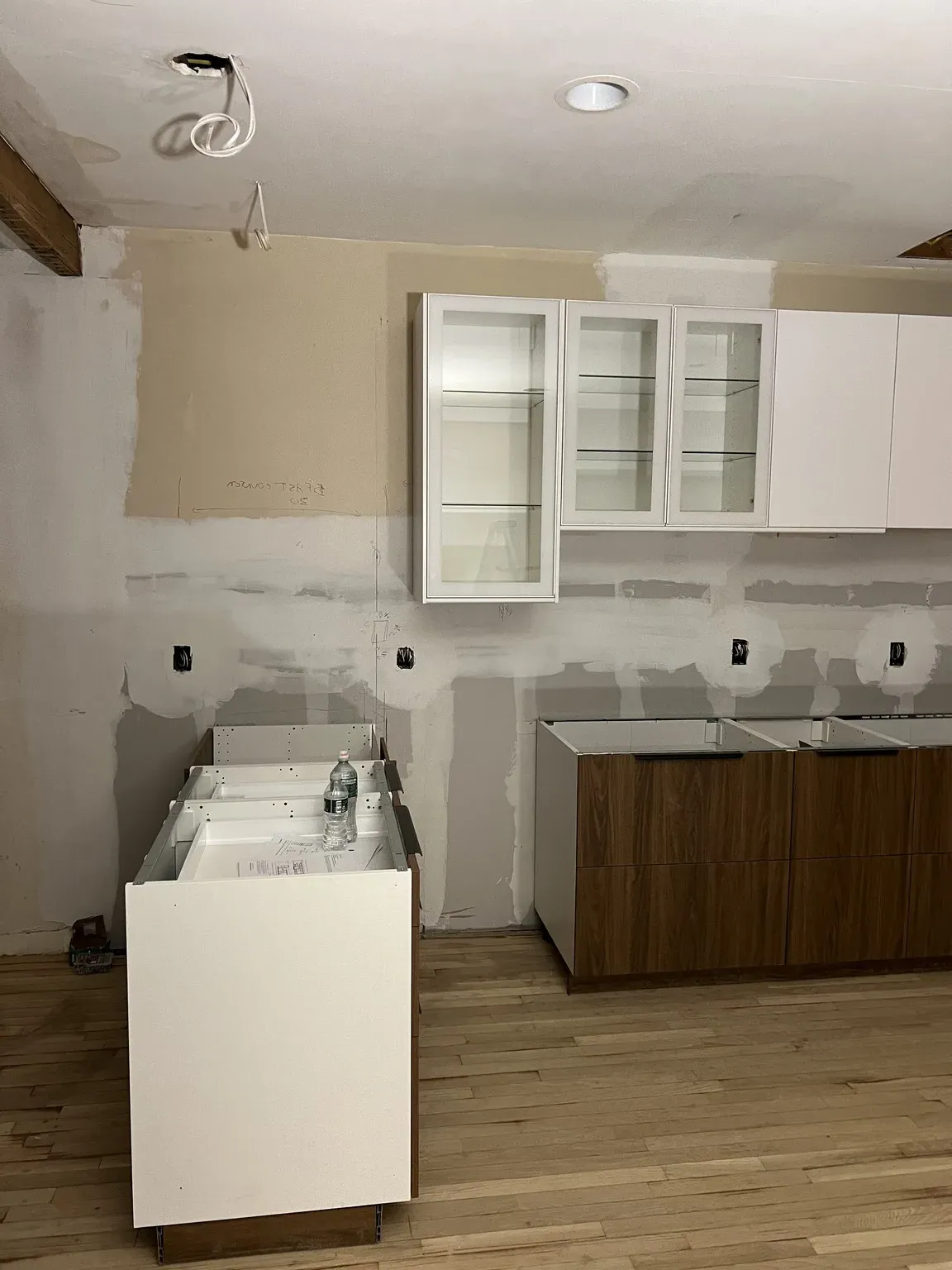
Schedule plumber and electrician. Plumbing rough-in (moving supply lines and drains) and electrical rough-in (adding circuits, moving outlets) must be done before cabinet installation.
-
Demolish old kitchen. Remove old cabinets, countertops, and backsplash. Dispose of debris properly per your local regulations.
-
Complete plumbing rough-in. Water supply and drain pipes in final positions per the new kitchen plan.
-
Complete electrical rough-in. Outlets and circuits in final positions. Add outlets for under-cabinet lighting if hardwiring.
-
Repair walls. Patch drywall, skim coat if needed, prime and paint. Cabinet installation goes against finished walls.
-
Install new flooring (if applicable). IKEA cabinets sit on top of finished flooring. Install flooring first.
-
Verify that all IKEA boxes are present and accounted for. Cross-reference your order list. Do this days before installation, not the morning of — if something is missing, you need time to get it.
-
Set up a temporary kitchen. A folding table with a microwave, coffee maker, paper plates, and basic utensils in another room. You will be without a kitchen for 2-4 weeks.
-
Clear a staging area. The installation team needs room to assemble cabinets. Clear a dining room, living room, or garage area near the kitchen.
Phase 5: Installation Day
-
Verify the installation plan with the lead installer during the morning walkthrough.
-
Be available for questions. The installer may need decisions about filler placement, handle drilling locations, or other details.
-
Keep children and pets away from the work area.
-
Do the final walkthrough with the installer. Check every door, every drawer, every filler. Flag any issues before the team leaves. See our installation day guide.
Phase 6: Post-Installation (2-4 Weeks After Cabinets)
-
Schedule countertop template. Contact your fabricator as soon as cabinets are installed.
-
Install countertops. After fabrication (typically 1-2 weeks after template).
-
Complete plumbing finish. Install sink, faucet, garbage disposal, and dishwasher connection after countertops are in.
-
Install backsplash. After countertops, before final paint touch-ups.
-
Install under-cabinet lighting. Connect and test all light fixtures.
-
Install handles and hardware. Drill and mount handles/knobs on all doors and drawers.
-
Touch-up paint. Address any wall marks from installation and paint cut-ins around new cabinets.
-
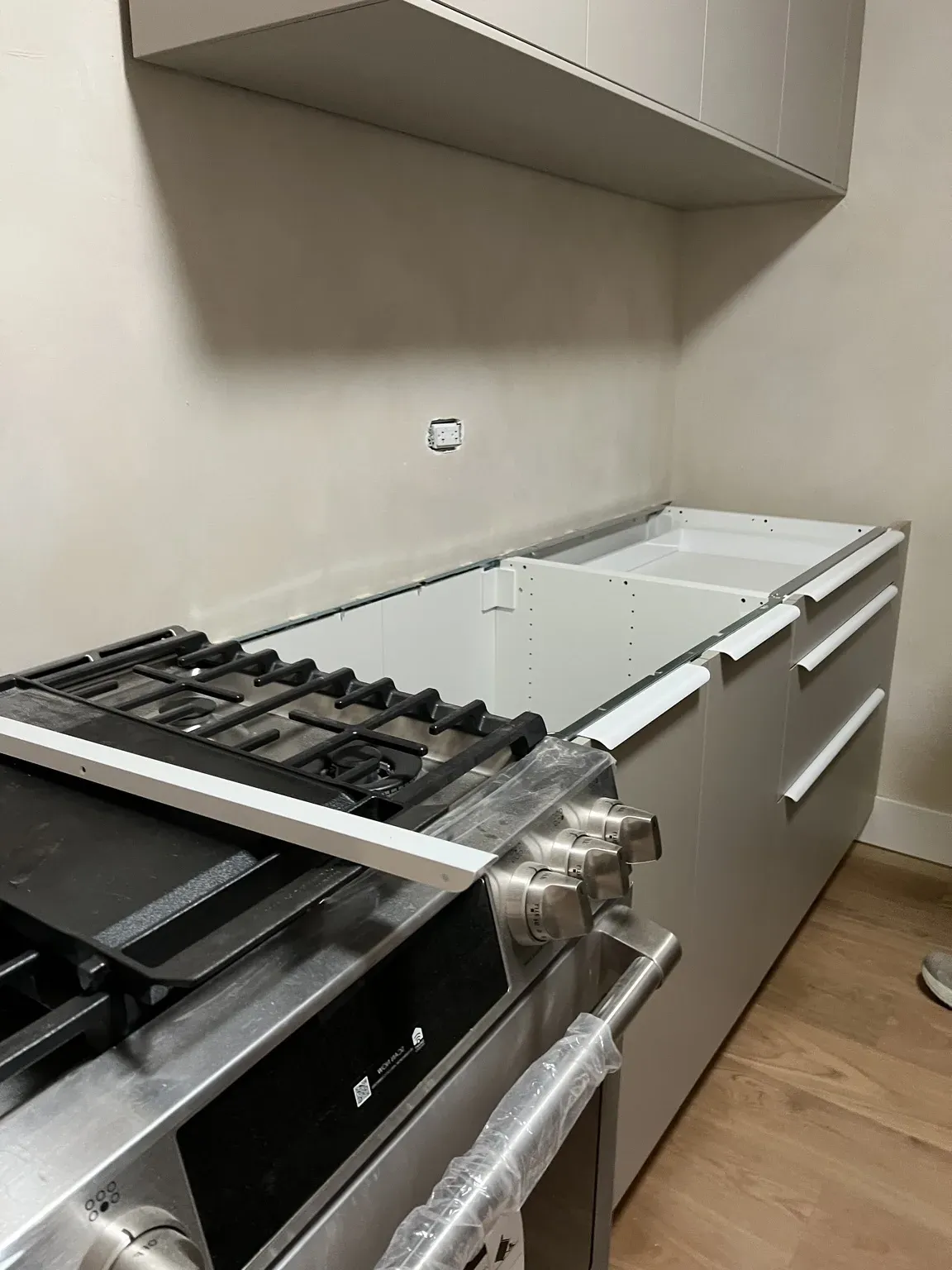
Install remaining appliances. Set range, connect dishwasher, place refrigerator.
-
Final cleaning. Deep clean all cabinet interiors (sawdust and installation debris accumulate) and countertops.
-
Organize cabinet interiors. Install drawer organizers, shelf clips, and interior accessories. Put everything in its place.
-
Enjoy your new kitchen. You earned it.
Bonus: Things People Forget
These are items that get overlooked regularly:
-
Outlet covers and light switch plates. Your old ones may not match the new kitchen aesthetic. New white or decorative plates are inexpensive and make a surprising difference.
-
Window treatments. New kitchen, old curtains? Update them to match.
-
Garbage disposal. If you are getting a new sink, decide in advance whether you want a disposal installed. It requires a dedicated electrical outlet under the sink.
-
Water filter. If you want a water filtration system (under-sink or faucet-mounted), plan for it during the plumbing phase.
-
Dishwasher door panel. If using a panel-ready dishwasher, order the matching IKEA door panel with your cabinet order. See our dishwasher guide.
-
Range hood or ventilation. Decide between an over-the-range microwave, a wall-mounted range hood, or a cabinet-insert range hood. This affects the upper cabinet layout above the range.
This checklist represents everything we have learned from installing IKEA kitchens across Massachusetts, Connecticut, and Rhode Island. At Hearthstone Kitchens, we manage every item on this list for our clients — so you can focus on the fun parts (choosing colors and planning dinner parties) while we handle the logistics.
Contact us and let's get your project started the right way.
Frequently asked questions
About the authors
This guide was written and reviewed by the Hearthstone Kitchens installation team, who have installed 600+ IKEA kitchens in Massachusetts, Connecticut and Rhode Island over 7+ years. Prices reflect what we see on real quotes in 2026 and are updated when the market moves. We are an independent installer and are not affiliated with IKEA.
Ready to talk about ikea cabinet assembly?
Upload your IKEA plan or a few photos. We will check it for missing pieces and send an itemized estimate within 3 hours, free and with no obligation.