Cost
$150–$400 to install; plumber for hookup
Time
1–2 hours
Difficulty
Moderate
Tools
Drill, level, screwdriver, licensed plumber for water and drain
On this page
A dishwasher is a standard feature in almost every kitchen renovation. It seems straightforward — slide it in, hook it up, done. But in an IKEA SEKTION kitchen, there are specific considerations for the dishwasher opening, the decorative door panel, plumbing connections, and securing the unit. Getting these details right ensures your dishwasher works properly, looks seamless, and stays in place.
Dishwasher Cabinet Requirements
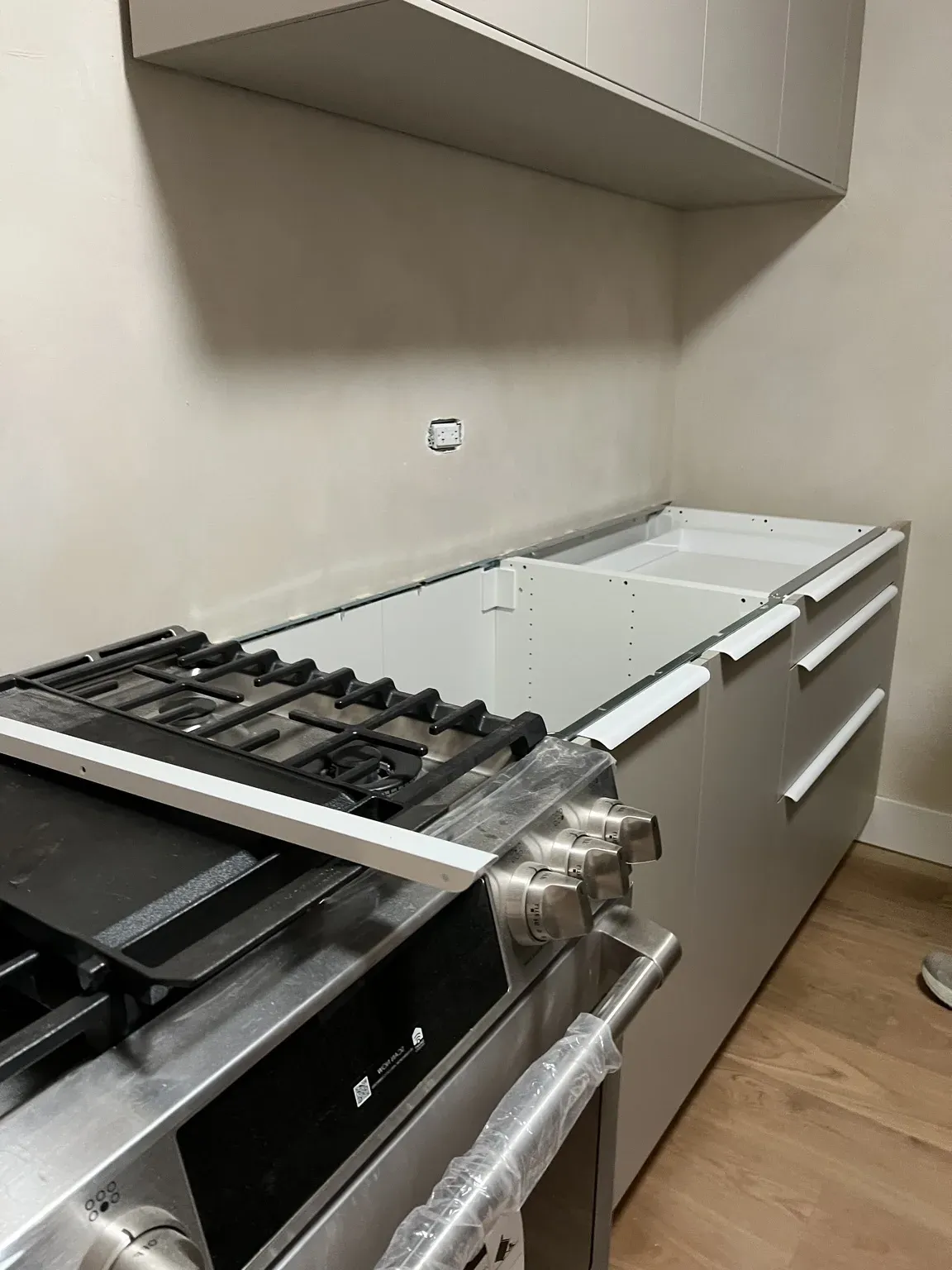
In an IKEA SEKTION kitchen, the dishwasher does not actually sit inside a cabinet. It occupies a 24-inch-wide opening between two base cabinets, with a countertop above and the floor below. However, the surrounding cabinets and countertop must be configured correctly:
Opening width: 24 inches is standard. IKEA's kitchen planning tool automatically creates this opening when you add a dishwasher to the design. The cabinets on either side of the opening provide the walls.
Height clearance: The opening from the finished floor to the underside of the countertop should be approximately 34 to 34.5 inches. IKEA base cabinets with their adjustable legs create a standard 34.5-inch counter height (with a 1.5-inch countertop). Most dishwashers fit within this range using their built-in adjustable feet.
Depth: Standard dishwashers are 24 inches deep. The IKEA base cabinet depth is also 24 inches, so the dishwasher should sit roughly flush with the cabinet fronts (the door panel will project slightly, matching the adjacent cabinet door faces).
IKEA Dishwasher Panel Installation
The dishwasher panel is what makes your dishwasher blend seamlessly with the rest of your IKEA kitchen. Instead of a stainless steel dishwasher face, you see a panel that matches your cabinet doors.
Panel-Ready vs. Non-Panel Dishwashers
Panel-ready dishwashers have a flat front face designed to accept a decorative panel. The front of the dishwasher is essentially a blank canvas with mounting brackets or screw holes for attaching a custom panel. Most mid-range and higher dishwashers (Bosch, KitchenAid, Miele, etc.) offer panel-ready models.
Non-panel dishwashers have their own finished front (usually stainless steel or black stainless). These do not accept a decorative panel. They look fine but do not blend with the cabinet fronts.
Our recommendation: For IKEA kitchens, we almost always recommend a panel-ready dishwasher with an IKEA door panel. The seamless look is one of the design details that makes an IKEA kitchen look custom.
How the IKEA Panel Attaches
IKEA sells specific dishwasher door panels in each of their door styles. The panel is the same width and finish as the adjacent cabinet doors, and it is designed to mount to a panel-ready dishwasher.
Installation process:
- Slide the dishwasher into the opening (without the panel attached).
- Level the dishwasher using its adjustable feet. Check front-to-back and side-to-side with a level.
- Secure the dishwasher (more on this below).
- Attach the IKEA mounting bracket to the dishwasher door. IKEA provides a bracket system that connects the decorative panel to the dishwasher door.
- Mount the decorative panel onto the bracket. Align it with the adjacent cabinet doors.
- Adjust alignment. The mounting brackets allow for slight adjustments to ensure the panel sits perfectly in line with the surrounding doors.
- Attach the handle or push-to-open mechanism to the panel.
Key detail: The IKEA panel dimensions are designed for specific dishwasher makes and models. When purchasing, verify that the IKEA panel mounting system is compatible with your chosen dishwasher brand. Bosch is the most universally compatible with IKEA panels. Some other brands may require adapter brackets or modifications.
Plumbing Requirements
Dishwashers need three plumbing/utility connections:
Water Supply
Hot water supply line connects to the dishwasher's inlet valve. In most kitchens, this tees off the hot water supply under the kitchen sink.
- Use a 3/8-inch compression fitting or braided stainless supply line
- The supply valve should be easily accessible under the sink cabinet (for emergencies)
- Running the supply line from the sink cabinet to the dishwasher opening typically goes through a hole drilled in the shared cabinet wall
Drain
The dishwasher drain line connects to the kitchen sink drain or garbage disposal.
Important code requirements in New England:
- High loop: Most MA, CT, and RI plumbing codes require the dishwasher drain hose to be looped up as high as possible under the countertop before connecting to the drain. This prevents dirty water from the sink backing up into the dishwasher.
- Air gap: Some jurisdictions require an air gap device (a small fitting mounted on the countertop or sink) instead of or in addition to a high loop. Check your local code.
- The drain line typically runs from the dishwasher through the same hole in the shared cabinet wall and connects to the sink tailpiece or disposal inlet.
Electrical
Dishwashers require a dedicated 15-amp or 20-amp electrical circuit. In new construction, this is a dedicated circuit from the electrical panel with a junction box behind the dishwasher or under the adjacent sink cabinet.
In older New England homes, the existing kitchen wiring may not include a dedicated dishwasher circuit. Your electrician may need to run a new circuit from the panel. In Massachusetts, this requires a licensed electrician and typically a permit.
Hardwired vs. plug-in: Some dishwashers are hardwired (permanently connected to a junction box), while others have a standard plug that goes into an outlet under the adjacent cabinet. Check your dishwasher's specs and local code requirements.
Securing the Dishwasher
This is critically important and often done incorrectly:
Why securing matters: A dishwasher that is not properly secured can tip forward when the door is open and the racks are loaded. This is a safety hazard, especially in households with children. The weight of a fully loaded lower rack, with the door open, can cause an unsecured dishwasher to tip.
How to secure in an IKEA kitchen:
Most dishwashers have anti-tip brackets that screw into the underside of the countertop. With IKEA's SEKTION system, the countertop sits on top of the base cabinets, and the dishwasher tucks under the countertop.
Challenge: IKEA uses particleboard countertops (for laminate options) or the countertop sits on a plywood substrate. The anti-tip screws must go into solid material. If you have a quartz or granite countertop, you cannot screw directly into the stone.
Solutions:
- Screw into the countertop's plywood substrate (if applicable). Most quartz countertops have a plywood buildup strip along the front edge that provides a screwing surface.
- Screw into the adjacent cabinet sides. Some dishwashers have side-mount brackets.
- Use a mounting strip. Attach a thin wooden strip to the underside of the countertop overhang, then screw the dishwasher brackets into the strip.
IKEA's Own Dishwashers vs. Third-Party
IKEA sells dishwashers under their own branded names (MEDELSTOR, LAGAN, RENLIG), which are manufactured by Electrolux or Whirlpool. They are panel-ready and designed for SEKTION kitchens.
Pros of IKEA dishwashers:
- Guaranteed compatibility with IKEA panels
- Competitive pricing
- Available in-store for immediate purchase
Cons of IKEA dishwashers:
- Limited selection (typically 2-4 models)
- Reviews are mixed — they are adequate but rarely best-in-class
- Features trail behind dedicated appliance brands
Our recommendation: For most of our New England installations, we recommend Bosch dishwashers. They are the gold standard for panel-ready dishwashers — quiet, reliable, and with panels that align perfectly with IKEA door panels. The Bosch 300, 500, and 800 series all work beautifully in IKEA kitchens.
Other good third-party options: KitchenAid, Miele (premium), Fisher & Paykel (drawer-style).
Common Installation Issues and Fixes
Issue: Dishwasher panel not aligning with adjacent cabinet doors. Fix: Use the adjustment screws on the mounting bracket to fine-tune the panel position. Small shims behind the bracket can help with depth alignment.
Issue: Dishwasher vibrating or making noise during cycles. Fix: Ensure the dishwasher is perfectly level and the anti-tip brackets are tight. Check that the drain hose is not kinked or pressing against the cabinet wall.
Issue: Water leaking from under the dishwasher. Fix: Check all supply and drain connections. Ensure the door gasket is clean and seated properly. Check that the dishwasher is level (a tilted dishwasher can cause leaks).
Issue: Dishwasher door hitting the adjacent cabinet door or handle. Fix: This is a design planning issue. Ensure adequate clearance was planned between the dishwasher and adjacent cabinet doors. A thin filler panel between the dishwasher opening and the adjacent cabinet can solve this.
Installation Checklist
- Verify dishwasher dimensions match the opening
- Confirm panel-ready compatibility between dishwasher brand and IKEA panel
- Run hot water supply line with shut-off valve
- Run drain line with proper high loop or air gap
- Install dedicated electrical circuit (if not existing)
- Level dishwasher precisely using built-in adjustable feet
- Secure dishwasher with anti-tip brackets
- Mount IKEA door panel and align with adjacent doors
- Test all cycles before finalizing
- Check for leaks during first full cycle
At Hearthstone Kitchens, dishwasher installation is included as part of our complete IKEA kitchen installation service. We coordinate with plumbers and electricians to ensure everything is properly connected, secured, and looking seamless.
Contact us to discuss your IKEA kitchen project in Massachusetts, Connecticut, or Rhode Island.
About the authors
This guide was written and reviewed by the Hearthstone Kitchens installation team, who have installed 600+ IKEA kitchens in Massachusetts, Connecticut and Rhode Island over 7+ years. Prices reflect what we see on real quotes in 2026 and are updated when the market moves. We are an independent installer and are not affiliated with IKEA.
Ready to plan your IKEA kitchen?
Upload your IKEA plan or a few photos. We will check it for missing pieces and send an itemized estimate within 3 hours, free and with no obligation.