On this page
Nothing derails an IKEA kitchen installation faster than discovering your brand-new refrigerator is half an inch too wide for the cabinet opening. Or that your dishwasher is too tall for the counter height. Or that the microwave you purchased does not fit the space above the range.
Appliance fit issues are among the most common (and most frustrating) problems we encounter in IKEA kitchen installations. They are also entirely preventable with proper planning. This guide gives you every dimension you need to ensure your appliances fit perfectly in your IKEA SEKTION kitchen.
General Principles
Before diving into specific appliances, here are the key things to understand:
-
IKEA cabinets are designed for standard US appliance sizes. The SEKTION system accommodates the same appliance dimensions as any American kitchen cabinet system. You are not limited to IKEA appliances.
-
Always measure the actual appliance, not just the spec sheet. Manufacturer dimensions sometimes do not account for handles, hinges, or protruding plugs. Measure the actual unit you plan to install.
-
Plan for ventilation clearances. Most appliances need air space around them for proper ventilation. Ignoring this leads to overheating and shortened appliance life.
-
Consider door swing and clearance. A refrigerator door, dishwasher door, or oven door needs room to open fully without hitting adjacent cabinets, islands, or walls.
Refrigerator Compatibility
Refrigerators are the most challenging appliance to fit because they come in so many sizes and configurations.
Freestanding Refrigerators
Most homeowners use a freestanding refrigerator that sits between cabinets or at the end of a cabinet run.
Standard widths:
- 30 inches — compact, common in condos and smaller kitchens
- 33 inches — mid-size, very common
- 36 inches — full-size, the most popular for family homes
IKEA cabinet opening for refrigerators: The opening between cabinets should be 1/2 to 1 inch wider than the refrigerator. For a 36-inch fridge, plan a 36.5 to 37-inch opening. This can be achieved with specific cabinet widths and filler panels.
Height considerations: Standard refrigerators are 68-70 inches tall. Counter-depth models are about the same height. If you are installing an overhead cabinet above the fridge, the standard IKEA configuration uses a 15-inch tall wall cabinet mounted at the top of the wall cabinet line, with the space below it left open for the fridge.
Depth considerations: Standard-depth refrigerators are 30-34 inches deep (plus the door, which adds 2-3 inches). This means a standard fridge protrudes about 6-8 inches beyond the 24-inch deep base cabinets. Counter-depth models (about 24-25 inches deep, plus door) sit nearly flush with the cabinets and look much more built-in.
Our recommendation: If budget allows, a counter-depth refrigerator dramatically improves the look of an IKEA kitchen. The flush line between the fridge and cabinets looks intentional and custom. It is one of the most impactful aesthetic upgrades you can make.
Built-In/Panel-Ready Refrigerators
Some homeowners want a fully integrated refrigerator that accepts a cabinet panel on the door, making it virtually invisible. IKEA supports this with their SEKTION system — you can order a special fridge cabinet frame and attach IKEA door panels to a panel-ready refrigerator.
Panel-ready fridges are significantly more expensive than standard freestanding models, but the seamless, built-in look they create is hard to beat. Brands like Fisher & Paykel, Bosch, and Liebherr offer panel-ready models that work with IKEA panels.
Dishwasher Compatibility
Dishwashers are the easiest appliance to fit because they are highly standardized.
Standard dimensions:
- Width: 24 inches (this is universal for full-size dishwashers)
- Height: 33.5 to 34.5 inches (adjustable legs allow fine-tuning)
- Depth: 24 inches (not including door when open)
IKEA cabinet opening: IKEA's 24-inch dishwasher opening in the SEKTION system accommodates all standard dishwashers. The countertop provides the top constraint, and the base of the opening is the floor.
Critical measurement: The height from the finished floor to the underside of the countertop. Standard is about 34-34.5 inches. If you have a thick countertop (1.25 inches of quartz plus substrate), the total counter height may be slightly over 36 inches from the floor, which provides adequate clearance above a standard dishwasher.
Panel-ready dishwashers: Most IKEA kitchen installations use a panel-ready dishwasher with an IKEA door panel mounted on the front. This gives the dishwasher the same appearance as the adjacent cabinets. IKEA sells a specific dishwasher door panel in each of their door styles. See our dishwasher installation guide for details.
Ventilation: Dishwashers need adequate connection to the drain and water supply. In New England, local plumbing codes (which vary by municipality in MA, CT, and RI) may require specific installation details like a high-loop drain or an air gap device.
Range/Oven Compatibility
Freestanding ranges:
- Standard width: 30 inches (most common) or 36 inches (professional-style)
- Standard depth: 25-27 inches
- Standard height: 36 inches (matches countertop height with adjustable feet)
The 30-inch opening between base cabinets accommodates a standard range. For a 36-inch range, you need to plan the cabinet layout accordingly.
Important: Leave a 1/4-inch gap on each side of the range for ventilation and to prevent heat transfer to adjacent cabinets. IKEA's planning tool usually accounts for this, but double-check.
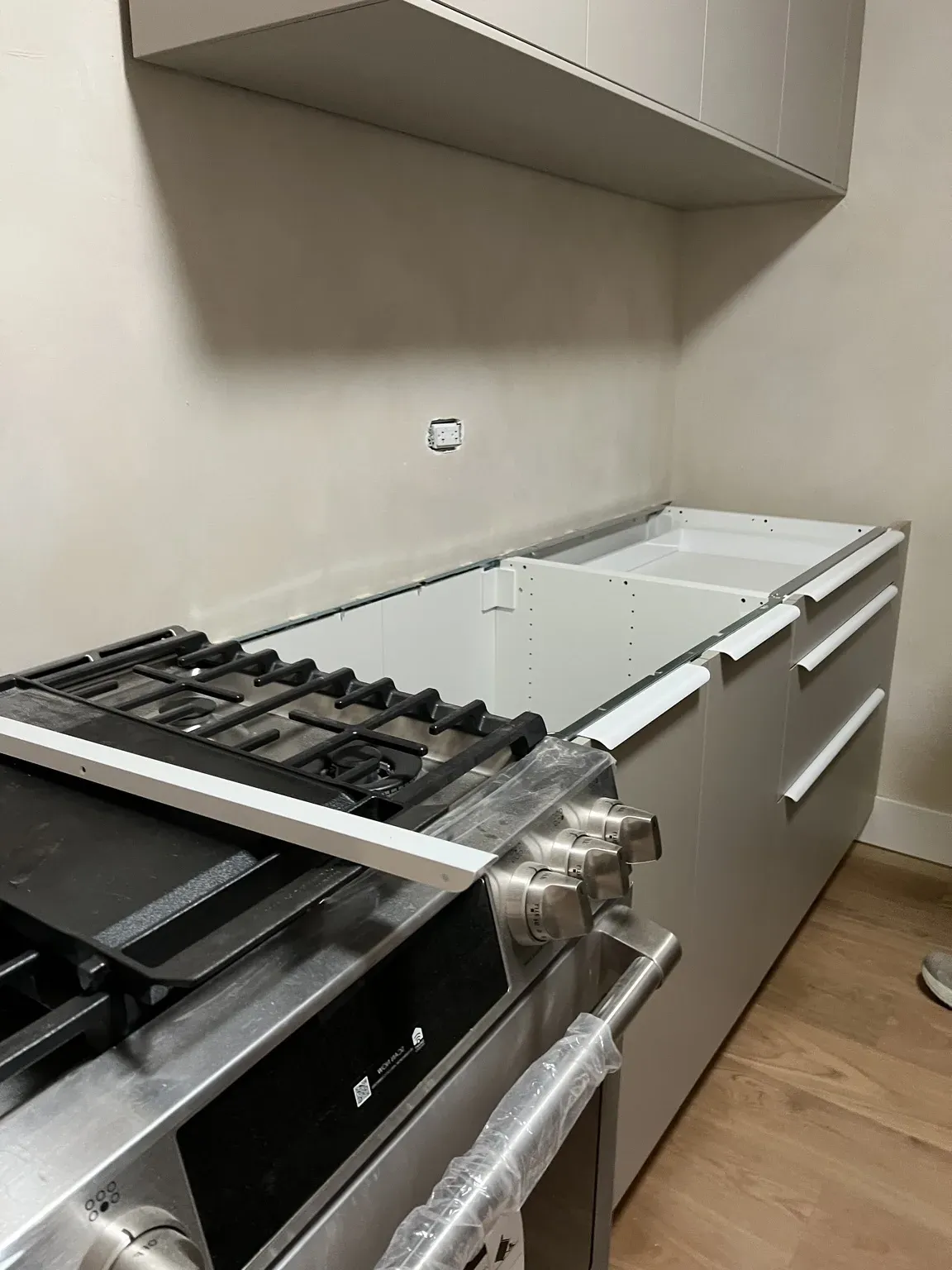
Slide-in vs. freestanding: Slide-in ranges have no backguard and overlap the countertop slightly on the sides, creating a built-in look. They require a precise opening — typically 30 inches wide — and the countertop must be cut to align with the range top. Freestanding ranges have a backguard and sit fully in the opening. Both work with IKEA cabinets.
Wall ovens: IKEA offers tall oven cabinets (SEKTION high cabinets) that accommodate standard 30-inch wall ovens. The cabinet provides the housing, and you slide the oven in and secure it per the oven manufacturer's instructions. Make sure to check the oven's depth clearance — it needs to fit within the 24-inch depth of the IKEA cabinet without protruding.
Cooktops (built-in): A cooktop drops into a cutout in the countertop above a base cabinet. The cutout dimensions must match the cooktop's specifications exactly. Most 30-inch cooktops need a cutout of about 28.5 x 19.5 inches, but always check the manufacturer's template. The base cabinet below should not have a drawer or full shelf — it needs to be open for the cooktop's underbody and electrical/gas connections.
Microwave Compatibility
Over-the-range (OTR) microwaves: These mount above the range with a bracket system and include a ventilation fan. Standard OTR dimensions are 30 inches wide x 15-17 inches tall x 15-16 inches deep. The wall cabinet above the range needs to be at least 12-15 inches high (IKEA's 15-inch wall cabinet works) and mounted at the correct height — typically 66 inches from the floor to the bottom of the cabinet, leaving about 13-18 inches between the cooktop and the bottom of the microwave.
Microwave drawer: Installs in a base cabinet. Standard 24 or 30-inch width. These are becoming popular in modern kitchens because they free up upper cabinet space.
Countertop microwave in a cabinet: Some homeowners put a countertop microwave in an open shelf or a cabinet with the door removed. Ensure adequate ventilation around all sides.
IKEA's Own Appliance Lines
IKEA sells appliances under several brand names, all manufactured by Whirlpool or Electrolux:
- MEDELSTOR — Mid-range dishwasher
- LAGAN — Budget dishwasher
- RENLIG — Another dishwasher option
- MATMASSIG — Cooktops
- KULINARISK — Wall ovens
- RAFFINERAD — Built-in ovens and microwaves
The advantage of IKEA appliances is guaranteed fit — they are designed specifically for SEKTION cabinets. The disadvantage is limited selection and middling reviews compared to dedicated appliance brands.
Our honest take: Most of our clients in New England choose their own appliances from brands like Bosch, GE, KitchenAid, Samsung, or LG. The selection is better, the features are more advanced, and the pricing is competitive. IKEA appliances are fine for a budget-conscious project, but they are not the strongest part of IKEA's kitchen offering.
Common Fit Issues and How to Avoid Them
Issue 1: Refrigerator too wide for the opening. Fix: Measure the actual fridge (including handles and hinges) and ensure the cabinet opening is at least 1/2 inch wider on each side.
Issue 2: Dishwasher too tall for the counter height. Fix: Most dishwashers have adjustable legs. If the dishwasher is still too tall, check that the IKEA cabinet legs are set to the correct height and that the countertop substrate is not adding unexpected thickness.
Issue 3: Range does not sit level with the countertop. Fix: Adjust the range's feet until the cooktop surface is level with the countertops on either side. A slight discrepancy is common and easily corrected.
Issue 4: Oven protruding beyond cabinet front. Fix: Check depth clearance before purchasing. Some ovens are deeper than the 24-inch IKEA cabinet allows.
Issue 5: Microwave blocking upper cabinet access. Fix: Verify clearances during the design phase. The microwave should not interfere with the adjacent wall cabinet doors.
Planning Checklist
Before finalizing your IKEA kitchen design, verify these dimensions for every appliance:
- Refrigerator width, height, and depth (including handles)
- Refrigerator door swing direction and clearance
- Dishwasher height and panel attachment method
- Range width and type (freestanding vs. slide-in)
- Cooktop cutout dimensions (if applicable)
- Wall oven dimensions and cabinet requirements
- Microwave type and mounting requirements
- Ventilation clearances for all heat-producing appliances
Get Professional Help
Appliance compatibility is one of the many details we verify during the design phase of every Hearthstone Kitchens project. Before a single cabinet is ordered, we confirm that every appliance fits perfectly in the planned layout. This prevents costly surprises on installation day.
Working on an IKEA kitchen project in Massachusetts, Connecticut, or Rhode Island? Contact us for a design review that includes full appliance compatibility verification.
About the authors
This guide was written and reviewed by the Hearthstone Kitchens installation team, who have installed 600+ IKEA kitchens in Massachusetts, Connecticut and Rhode Island over 7+ years. Prices reflect what we see on real quotes in 2026 and are updated when the market moves. We are an independent installer and are not affiliated with IKEA.
Ready to plan your IKEA kitchen?
Upload your IKEA plan or a few photos. We will check it for missing pieces and send an itemized estimate within 3 hours, free and with no obligation.