On this page
- Understanding Cape Cod Kitchen Challenges
- Understanding Colonial Kitchen Challenges
- Best IKEA Door Styles for Traditional New England Homes
- Color Palettes That Work
- Making IKEA Look High-End in a Traditional Home
- Crown Molding Integration Tips
- Hardware Selection Guide
- Real-World Example: Cape Cod Kitchen in Hyannis
- Getting It Right
New England is defined by its architecture. Drive through any town in Massachusetts, Connecticut, or Rhode Island and you will see Cape Cod cottages, Federal colonials, Georgian manors, saltbox houses, and Greek revival homes — most built between 1700 and 1960, many with kitchens that have been "updated" (sometimes well, sometimes badly) multiple times over the decades.
If you live in one of these homes and you are planning an IKEA kitchen renovation, the question you are probably asking is: can IKEA really look right in a traditional New England home? The answer is a confident yes — with the right design choices.
We have installed IKEA kitchens in cape-style homes from Chatham to Mystic, in colonials from Concord to Westerly, and in every type of traditional New England house in between. The results, when done thoughtfully, are stunning. Let's talk about how to get there.
Understanding Cape Cod Kitchen Challenges
Cape Cod style homes — the quintessential New England house — present several unique kitchen design challenges:
Low ceilings. Many capes have 7.5-foot to 8-foot ceilings on the first floor, and even lower upstairs if the kitchen is in a dormer addition. This limits wall cabinet height and makes the kitchen feel smaller. Solutions: Use 30-inch wall cabinets mounted at standard height and extend to the ceiling with crown molding or a thin soffit. The continuous vertical line from counter to ceiling makes the room feel taller.
Small footprint. Cape kitchens are typically compact. The original 1940s-1960s kitchen in a cape was often just 8x10 feet. Even expanded versions tend to be modest. This means every inch counts. IKEA's modular system is actually ideal here because you can configure cabinets in 3-inch increments to fill every available space.
Quirky layouts. Capes frequently have doors, stairways, or hallways opening into the kitchen that constrain cabinet placement. The kitchen might have an oddly placed window, a back door, or a chimney bump-out. These are annoyances with custom cabinets and near-impossibilities with big-box semi-custom sizes — but IKEA's flexible system handles them well.
Older infrastructure. Electrical systems, plumbing, and structural elements in cape homes often need updating as part of a kitchen renovation. The walls may be plaster over lath (not drywall), the wiring may be knob-and-tube that needs replacing, and the plumbing may be galvanized steel that is corroding. Plan for these potential issues in your budget.
Understanding Colonial Kitchen Challenges
Colonial homes — including Federals, Georgians, and Greek Revivals — have their own set of challenges:
Higher ceilings with formal proportions. Colonials typically have 8.5 to 9.5-foot ceilings, which is more generous than capes. This is actually great for IKEA kitchens because you can do stacked cabinets or taller wall cabinets. The key is making the cabinets feel proportional to the room.
Formal vs. informal tension. Colonials often have a formal dining room separate from the kitchen, and the kitchen itself was historically a utilitarian space. Modern renovations often open up the kitchen, but you need to be sensitive to the home's character. A kitchen that is too aggressively modern can feel jarring in a 1790 colonial.
Wide-plank flooring and molding details. Colonials often have beautiful original architectural details. Your kitchen design should complement these, not compete with them.
Best IKEA Door Styles for Traditional New England Homes
This is where IKEA's range really shines. Several door styles work beautifully in traditional architecture:
BODBYN (Off-White) — Our top recommendation for Cape Cod and colonial kitchens. The BODBYN door has a classic shaker-inspired profile with a warm off-white color that reads as traditional rather than sterile. It is the single most popular door style we install in New England traditional homes.
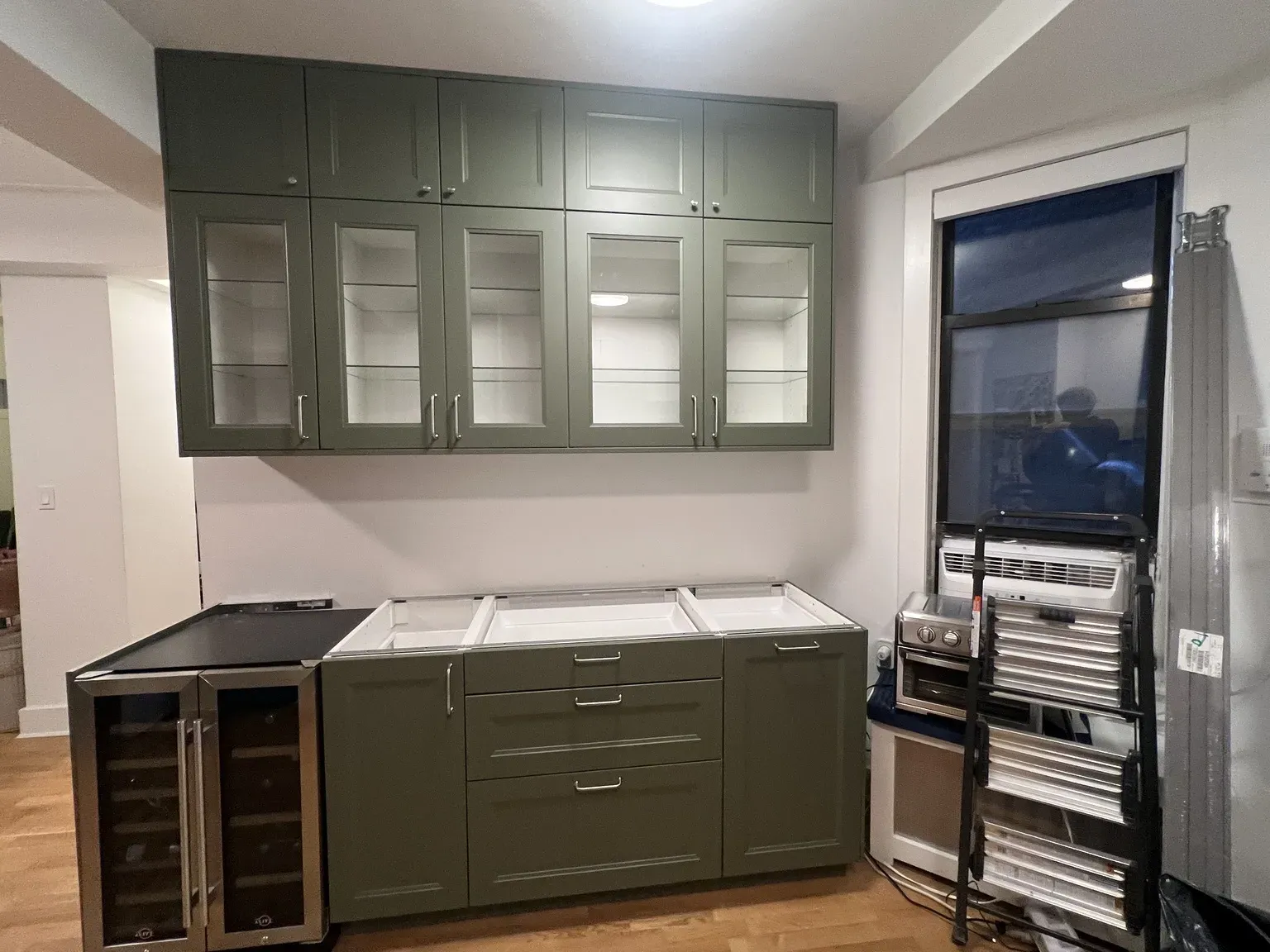
BODBYN (Gray) — A moodier alternative that works beautifully in colonials. The gray BODBYN pairs well with white walls, marble or quartz countertops, and brass or oil-rubbed bronze hardware. Very Restoration Hardware aesthetic at a fraction of the price.
LERHYTTAN (Black Stain) — For homeowners who want drama. The LERHYTTAN has a traditional panel profile in a dark black-stained finish. Looks incredible in a colonial with high ceilings, white walls, and brass accents. Think modern farmhouse with a New England twist.
AXSTAD (Matte White) — If you lean toward a cleaner aesthetic while still respecting the architecture, the AXSTAD matte white is a contemporary shaker profile that bridges traditional and modern. Works well in updated capes where you want a fresh, airy feel.
Avoid in traditional homes: RINGHULT (high-gloss) and VOXTORP (ultra-modern slab) feel out of place in Cape Cod and colonial architecture. They are fantastic doors for contemporary homes, but they clash with clapboard siding and hardwood floors.
Color Palettes That Work
New England traditional homes favor warm, inviting palettes. Here are our go-to combinations:
Classic White Kitchen:
- Cabinets: BODBYN off-white
- Countertops: White or gray-veined quartz (Calacatta-style)
- Backsplash: White subway tile (3x6 or 3x12)
- Hardware: Brushed brass or oil-rubbed bronze pulls
- Walls: BM White Dove or Swiss Coffee
- This is the most popular combination we install, and it works in virtually every traditional New England home.
Two-Tone Farmhouse:
- Upper cabinets: BODBYN off-white
- Base cabinets: LERHYTTAN black or BODBYN gray
- Countertops: Butcher block (for an island or prep area) plus quartz (for perimeter)
- Hardware: Matte black cup pulls and knobs
- A showstopper combination that photographs beautifully and lives even better.
Coastal Cape Cod:
- Cabinets: AXSTAD matte white
- Countertops: Light gray quartz
- Backsplash: Light blue or seafoam glass tile
- Hardware: Brushed nickel or chrome pulls
- Walls: Soft blue or gray
- Light, airy, and reminiscent of the coast. Perfect for cape homes in Falmouth, Narragansett, or Mystic.
Warm Colonial:
- Cabinets: BODBYN off-white with ASKERSUND (light ash) for an island
- Countertops: Warm-toned quartz or soapstone
- Backsplash: Hand-glazed ceramic tile in cream
- Hardware: Antique brass knobs
- Rich and welcoming without feeling dark or heavy.
Making IKEA Look High-End in a Traditional Home
Here are the specific tactics that elevate an IKEA kitchen from "budget renovation" to "it looks custom":
-
Add crown molding. Nothing says traditional New England kitchen like crown molding at the ceiling line. Use IKEA's FORBATTRA molding or, better yet, use stock crown molding from a local lumber yard for a more authentic profile. Match it to the home's existing molding style.
-
Use cover panels on all exposed sides. Every visible cabinet side should be covered with a panel that matches the door finish. This makes the cabinets look like built-in furniture.
-
Upgrade hardware. IKEA's handles are fine, but third-party hardware elevates the look immediately. Bin pulls, cup pulls, and knobs in unlacquered brass or oil-rubbed bronze scream New England traditional.
-
Choose a statement sink. A farmhouse sink (IKEA's HAVSEN or a Kohler Whitehaven) is practically mandatory in a Cape Cod or colonial kitchen.
-
Add under-cabinet lighting. LED strip lights or puck lights under the wall cabinets create warmth and ambiance. They also highlight a beautiful backsplash.
-
Select the right countertop. Quartz countertops that mimic marble (like Cambria Brittanicca) give a high-end, traditional look. For a more rustic feel, consider honed granite or soapstone, which is a New England classic.
-
Use glass-front cabinets strategically. IKEA offers glass doors for wall cabinets. Place them at key focal points to display nice dishware and break up a long run of solid doors.
Crown Molding Integration Tips
Crown molding deserves extra attention because it is so important in traditional homes:
- Match the profile to the existing molding in your home. If your living room has ogee crown molding, carry that profile into the kitchen.
- Size it proportionally. In a room with 8-foot ceilings, 3-4 inch molding is appropriate. In a room with 9-foot ceilings, go up to 5-6 inches.
- Build a nailer strip along the top of the IKEA wall cabinets for the molding to attach to. The nailer provides a solid mounting surface.
- Miter inside corners, cope outside corners. Yes, this is fussy work. It is also what separates a professional installation from a weekend project.
- Paint the molding to match. If your cabinets are BODBYN off-white, paint the molding the same shade. A white molding on off-white cabinets will look mismatched.
Hardware Selection Guide
| Home Style | Handle Style | Finish | Examples |
|---|---|---|---|
| Cape Cod | Cup pulls + knobs | Brushed nickel or chrome | Amerock Allison, Rejuvenation Massey |
| Federal Colonial | Bar pulls + knobs | Antique brass | Schoolhouse Utilitarian, Rejuvenation Boyd |
| Georgian | Bail pulls or ring pulls | Polished brass | House of Antique Hardware, Nostalgic Warehouse |
| Farmhouse | Cup pulls + bin pulls | Oil-rubbed bronze | Hickory Hardware, Top Knobs Devon |
| Updated Traditional | Simple bar pulls | Matte black or satin brass | Lewis Dolin, Emtek |
Real-World Example: Cape Cod Kitchen in Hyannis
One of our favorite recent projects was a 1952 Cape Cod in Hyannis, Massachusetts. The original kitchen was just 9x11 feet with a low 7.5-foot ceiling, one window, and a door to the backyard eating into the layout.
We designed the kitchen with:
- BODBYN off-white cabinets on all walls
- 30-inch wall cabinets with crown molding extending to the ceiling
- A blind corner solution with pull-out organizers (saving precious space)
- NORRSJON undermount sink in a 30" sink cabinet
- Calacatta-look quartz countertops
- Brushed brass cup pulls
- Under-cabinet LED lighting
- A narrow 9-inch pull-out cabinet for spices beside the range
Getting It Right
Designing an IKEA kitchen for a traditional New England home requires more thought than simply ordering cabinets and installing them. It requires understanding the architecture, choosing complementary styles, and executing the finishing details that make the kitchen feel like it belongs in the house.
At Hearthstone Kitchens, we specialize in exactly this — making IKEA kitchens look and feel custom in New England's beautiful old homes. Contact us for a free design consultation and let's create a kitchen that honors your home's character while giving you all the modern functionality you need.
About the authors
This guide was written and reviewed by the Hearthstone Kitchens installation team, who have installed 600+ IKEA kitchens in Massachusetts, Connecticut and Rhode Island over 7+ years. Prices reflect what we see on real quotes in 2026 and are updated when the market moves. We are an independent installer and are not affiliated with IKEA.
Ready to plan your IKEA kitchen?
Upload your IKEA plan or a few photos. We will check it for missing pieces and send an itemized estimate within 3 hours, free and with no obligation.